
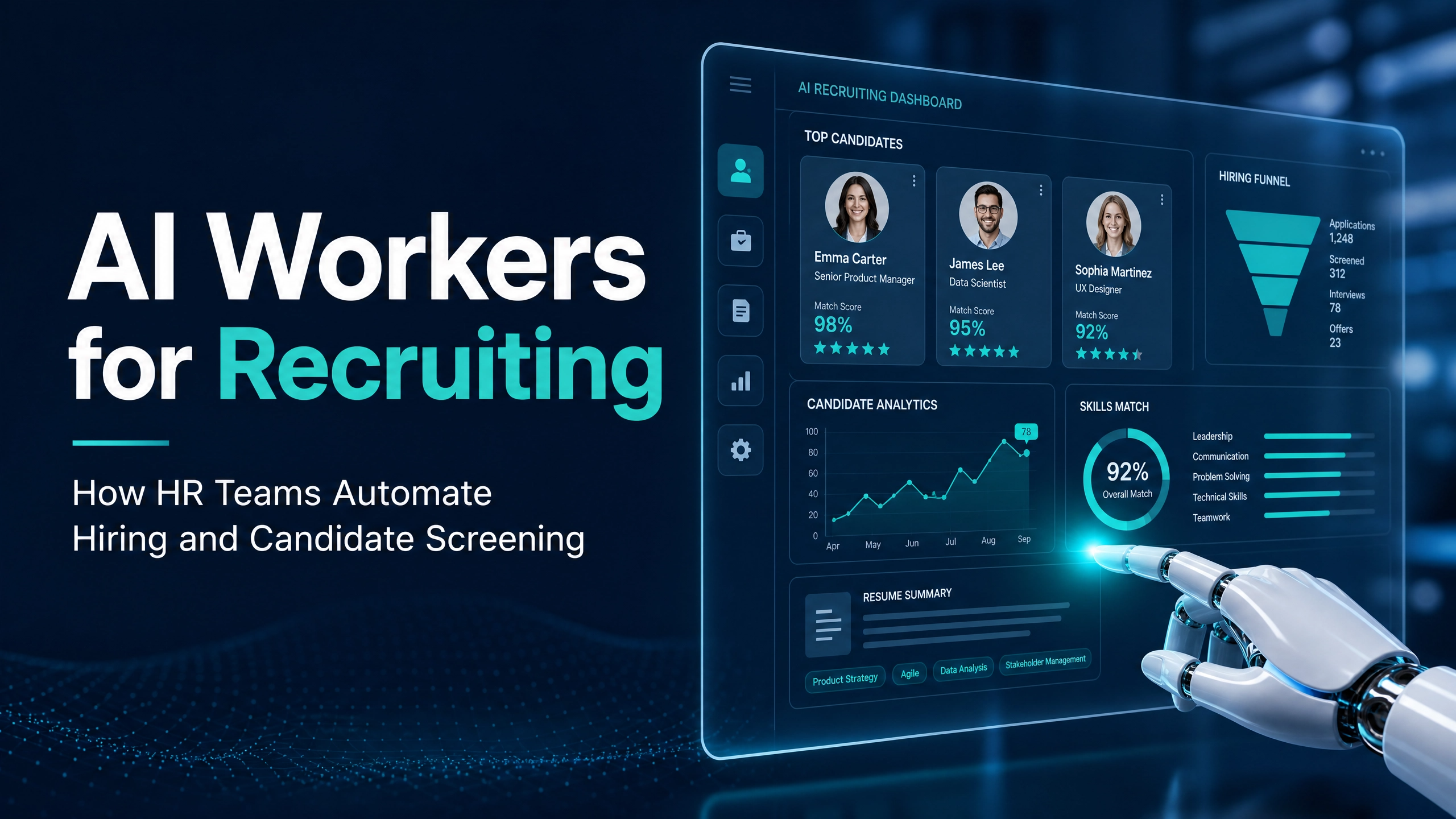
Learn how AI Workers for Recruiting help HR teams automate candidate screening, interview scheduling, hiring workflows, and recruiter communications to improve efficiency, reduce administrative workload, and accelerate time-to-hire.
Key Takeaways
- AI workers help HR teams automate repetitive recruiting tasks such as resume screening, candidate communication, interview scheduling, and hiring coordination.
- AI-powered recruiting workflows reduce time-to-hire and improve operational efficiency for hiring teams.
- Freddie HR, the recruiting AI worker on Aiwork, helps automate candidate screening, ranking, communication, and workflow management.
- Human recruiters remain essential for relationship-building, interviews, and final hiring decisions.
- Modern AI recruiting systems integrate with ATS, HRIS, and communication platforms to support scalable hiring operations.
Recruiting has become significantly more demanding for modern HR teams. Companies are receiving larger volumes of applications, hiring across multiple locations, and competing for talent in increasingly crowded markets. At the same time, recruiters are expected to move faster, communicate consistently, and maintain a strong candidate experience throughout the hiring process.
For many hiring teams, the biggest challenge is not finding recruiting software. It is managing the growing operational workload that comes with hiring at scale. Resume reviews, interview coordination, candidate follow-ups, and internal approvals can quickly become time-consuming administrative tasks that slow down the entire recruitment process.
This is where AI workers are beginning to reshape recruiting operations.
AI workers are designed to automate repetitive hiring workflows while helping recruiters stay organized, responsive, and efficient. Instead of functioning only as passive software systems, AI workers for recruiting actively assist with screening candidates, ranking applicants, scheduling interviews, and coordinating hiring workflows across teams.
In this article, the AI worker being referenced is Freddie HR, the recruiting and hiring model available on the Aiwork platform. Freddie HR is built to support HR teams by automating candidate screening, communication, scheduling, and recruitment workflow management.
As recruiting demands continue to grow, AI-powered hiring automation is becoming less of a competitive advantage and more of an operational necessity for many organizations.
What Are AI Workers for Recruiting?
AI Workers for Recruiting are AI-powered systems designed to automate repetitive hiring tasks such as candidate screening, resume analysis, interview scheduling, applicant communication, and recruitment workflow management. Unlike traditional recruiting software that primarily stores candidate information, AI workers actively assist HR teams by executing tasks, organizing workflows, and helping recruiters move qualified candidates through the hiring process more efficiently.
The goal is not to replace recruiters. The goal is to reduce administrative workload so recruiters can focus more on evaluating candidates, building relationships, and making strategic hiring decisions.
Freddie HR and AI Recruiting Automation
Freddie HR is the AI recruiting worker available on the Aiwork platform. It is designed specifically to help HR teams automate recruiting and hiring workflows.
Freddie HR assists with:
- Reviewing and ranking resumes
- Coordinating interview scheduling
- Managing recruiting communication
- Organizing hiring workflows
- Tracking candidate progression
By automating repetitive hiring tasks, Freddie HR helps reduce delays and improve recruiting efficiency across the hiring pipeline.
AI Workers for Recruiting vs Traditional ATS Platforms
Traditional Applicant Tracking Systems, commonly called ATS platforms, are primarily designed to organize and store candidate data. They help recruiters manage applications, job postings, and hiring stages.
AI workers go a step further.
Instead of only storing information, AI workers actively participate in recruiting workflows. They can automatically review resumes, identify qualified candidates, trigger communication workflows, and support hiring coordination across teams.
This distinction is important because many companies already use ATS platforms but still struggle with operational bottlenecks caused by manual recruiting tasks.
Why HR Teams Are Adopting AI Recruiting Automation
Recruiting teams are under increasing pressure to hire faster while managing larger candidate pipelines. This has made automation a growing priority for organizations of all sizes.
Increasing Application Volumes
Many companies now receive hundreds or even thousands of applications for a single role. Manually reviewing every resume can become overwhelming for recruiters, especially when hiring across multiple positions simultaneously.
AI workers help reduce this burden by automatically organizing, filtering, and ranking candidates based on predefined hiring criteria. For a broader look at how modern hiring teams are leveraging recruiting technology, this guide on AI recruitment tools explores practical approaches to improving candidate screening and hiring efficiency.
Faster Hiring Cycles
Long hiring timelines can lead to lost candidates and operational delays. Skilled candidates often receive multiple offers quickly, making responsiveness critical for recruiting teams.
AI recruiting workflows help reduce time-to-hire by automating screening, communication, and scheduling tasks that traditionally slow down the process.
Reduced Administrative Work
A large portion of recruiting involves repetitive operational tasks such as sending emails, scheduling interviews, updating candidate statuses, and coordinating internal feedback.
AI workers help automate these workflows, giving recruiters more time to focus on high-value hiring activities.
More Consistent Candidate Evaluation
Manual screening can sometimes lead to inconsistent evaluations, especially when multiple recruiters are involved in the hiring process.
AI-powered candidate screening systems help standardize evaluation criteria, ensuring applicants are reviewed more consistently across hiring workflows.
How AI Workers Automate Candidate Screening
Candidate screening is one of the most time-consuming parts of recruiting. AI workers help simplify this process by automatically reviewing applicant data and identifying qualified candidates more efficiently.
Resume Parsing and Data Extraction
AI workers for recruiting can analyze resumes and extract key information such as:
- Skills
- Work experience
- Certifications
- Education history
- Technical qualifications
This allows recruiters to search and organize candidates more effectively without manually reviewing every application line by line.
Automated Candidate Matching
AI recruiting systems can compare applicant qualifications against job requirements to identify strong matches.
For example, Freddie HR can help prioritize candidates based on:
- Relevant experience
- Required technical skills
- Industry background
- Role-specific qualifications
This helps recruiters identify qualified applicants more quickly.
AI Candidate Ranking
AI workers can automatically rank applicants based on hiring criteria established by recruiters and hiring managers.
Instead of sorting through large candidate pools manually, recruiters receive a prioritized list of applicants who best match the role requirements.
This can significantly reduce screening time during high-volume hiring periods.
Qualification Filtering
AI workers can also support pre-screening workflows by filtering candidates based on specific eligibility requirements.
Examples include:
- Years of experience
- Certifications
- Location requirements
- Technical competencies
- Work authorization status
This helps recruiters focus on candidates who meet the minimum requirements for a role.
How AI Workers Automate Recruiting Workflows
Recruiting involves much more than screening resumes. Coordinating interviews, managing communication, and organizing internal hiring workflows can consume a large amount of recruiter time.
AI workers help automate many of these operational tasks.
Automated Candidate Communication
One of the biggest frustrations for job seekers is inconsistent communication during the hiring process.
AI workers help improve communication by automating:
- Application confirmations
- Interview invitations
- Scheduling updates
- Follow-up reminders
- Candidate status notifications
Freddie HR helps maintain professional communication workflows while reducing manual email management for recruiters.
Interview Scheduling
Scheduling interviews often requires multiple back-and-forth emails between recruiters, candidates, and hiring managers.
AI workers simplify this process by coordinating calendars, identifying availability, and automating scheduling workflows.
This helps reduce delays and improves the overall candidate experience.
Hiring Team Coordination
Recruiting frequently involves collaboration between recruiters, department managers, executives, and HR personnel.
AI workers can help organize:
- Internal approvals
- Interview feedback
- Candidate evaluations
- Hiring stage updates
This improves workflow visibility and reduces communication bottlenecks.
Recruitment Pipeline Tracking
AI-powered workflow systems help recruiters track candidates throughout the hiring process.
This includes:
- Application status tracking
- Hiring stage progression
- Workflow reminders
- Recruitment reporting
Centralized visibility helps teams stay organized while managing large candidate pipelines.
Human Recruiters vs AI Workers
Despite the growing role of automation, AI workers are not replacing human recruiters.
Instead, they are helping recruiters operate more efficiently by reducing repetitive operational work.
Where AI Workers Perform Best
AI workers are highly effective at:
- Processing large amounts of candidate data
- Automating repetitive workflows
- Managing scheduling logistics
- Organizing recruitment pipelines
- Supporting operational efficiency
These are areas where automation can save recruiters significant time.
Where Human Recruiters Remain Essential
Human recruiters still play a critical role in:
- Relationship-building
- Candidate interviews
- Assessing communication skills
- Evaluating culture fit
- Negotiating offers
- Strategic hiring decisions
Recruiting remains a people-focused function, particularly for leadership and specialized roles.
The Importance of Human Oversight
AI-generated recommendations should support recruiters, not fully replace hiring judgment.
Recruiters still need to:
- Review candidate recommendations
- Validate hiring decisions
- Monitor fairness
- Handle complex hiring scenarios
Maintaining human oversight helps reduce the risks associated with over-automation.
How AI Workers Integrate With HR Systems
Modern recruiting operations rely on multiple systems working together. AI workers are most effective when integrated into broader HR and recruiting infrastructure.
ATS Integration
AI workers can integrate with Applicant Tracking Systems to synchronize candidate data, job postings, and workflow stages.
This helps maintain centralized recruiting operations without requiring recruiters to duplicate work across platforms.
HRIS Integration
Integration with Human Resource Information Systems allows recruiting workflows to connect more efficiently with onboarding and employee management processes.
Communication and Calendar Tools
AI workers often connect with:
- Email systems
- Messaging platforms
- Scheduling tools
- Calendar applications
This enables smoother communication and interview coordination workflows.
Recruitment Analytics
AI-powered systems can also provide visibility into:
- Hiring performance
- Recruitment bottlenecks
- Candidate conversion rates
- Time-to-hire metrics
These insights help organizations improve recruiting efficiency over time.
Challenges and Ethical Considerations
While AI recruiting automation offers significant operational benefits, organizations still need to approach implementation carefully.
Hiring Bias Risks
AI systems can unintentionally reflect biases present in historical hiring data or poorly designed evaluation criteria.
Organizations should regularly review:
- Screening logic
- Ranking systems
- Qualification filters
- Hiring outcomes
Bias monitoring and human oversight remain essential.
Data Privacy and Compliance
Recruiting systems process sensitive candidate information, making data protection a major priority.
Companies using AI recruiting systems should ensure compliance with:
- Privacy regulations
- Employment laws
- Internal data security policies
Responsible candidate data handling is critical for maintaining trust.
Transparency and Explainability
Recruiters and candidates increasingly want visibility into how automated hiring systems make recommendations.
Organizations should prioritize transparency by:
- Clearly defining hiring criteria
- Documenting screening workflows
- Maintaining review processes
This helps improve accountability and fairness.
What To Look For in an AI Recruiting Platform
Organizations evaluating AI recruiting solutions should focus on operational functionality rather than marketing claims alone.
Important factors include:
Workflow Automation Capabilities
Look for systems that automate practical recruiting tasks such as screening, scheduling, communication, and workflow coordination.
Integration Support
Strong integrations with ATS, HRIS, email, and calendar systems are essential for smooth recruiting operations.
Customization
Recruiting workflows vary significantly between organizations. Flexible configuration options are important for adapting automation to different hiring processes.
Analytics and Reporting
Visibility into recruiting performance helps organizations improve hiring efficiency and identify workflow bottlenecks.
Scalability
The platform should support both current and future hiring needs as recruiting operations grow.
The Future of AI Recruiting
AI recruiting technology is continuing to evolve beyond simple automation tools.
Future recruiting workflows may include:
- Autonomous recruiting coordination
- AI-generated candidate outreach
- Predictive hiring analytics
- Voice-based screening assistants
- Automated interview summarization
- Skills-based hiring intelligence
As these systems become more advanced, the role of recruiters will likely continue shifting toward relationship management, strategic hiring, and talent evaluation while AI workers handle more operational workflows.
FAQs
What are AI workers in recruiting?
AI workers are AI-powered systems that help automate hiring tasks such as candidate screening, interview scheduling, applicant communication, and recruitment workflow management.
What does Freddie HR do?
Freddie HR is the recruiting AI worker on Aiwork that helps HR teams automate resume screening, candidate ranking, interview coordination, hiring communications, and recruitment workflows.
Can AI workers replace recruiters?
No. AI workers automate repetitive recruiting tasks, but recruiters remain essential for interviewing candidates, building relationships, evaluating fit, and making final hiring decisions.
How do AI workers improve recruiting efficiency?
AI workers reduce manual administrative work by automating screening, scheduling, communication, and workflow coordination, helping recruiters hire faster and manage larger candidate pipelines.
What is the difference between an ATS and an AI worker?
An ATS primarily stores and tracks applicant information, while an AI worker actively automates recruiting tasks such as candidate screening, communication, scheduling, and workflow management.
Conclusion
As hiring demands continue to grow, HR teams need more efficient ways to manage candidate pipelines, reduce administrative work, and maintain a positive candidate experience. AI workers are helping organizations achieve this by automating time-consuming recruiting tasks such as resume screening, candidate communication, interview scheduling, and workflow coordination.
Freddie HR, the recruiting AI worker on Aiwork, supports these efforts by helping recruiters streamline hiring processes and focus more on evaluating talent rather than managing repetitive tasks. While automation can significantly improve recruiting efficiency, successful hiring still depends on human judgment, relationship-building, and strategic decision-making.
The future of recruiting is not about replacing recruiters with AI. It is about combining human expertise with AI-powered workflow automation to create faster, more scalable, and more effective hiring operations.