
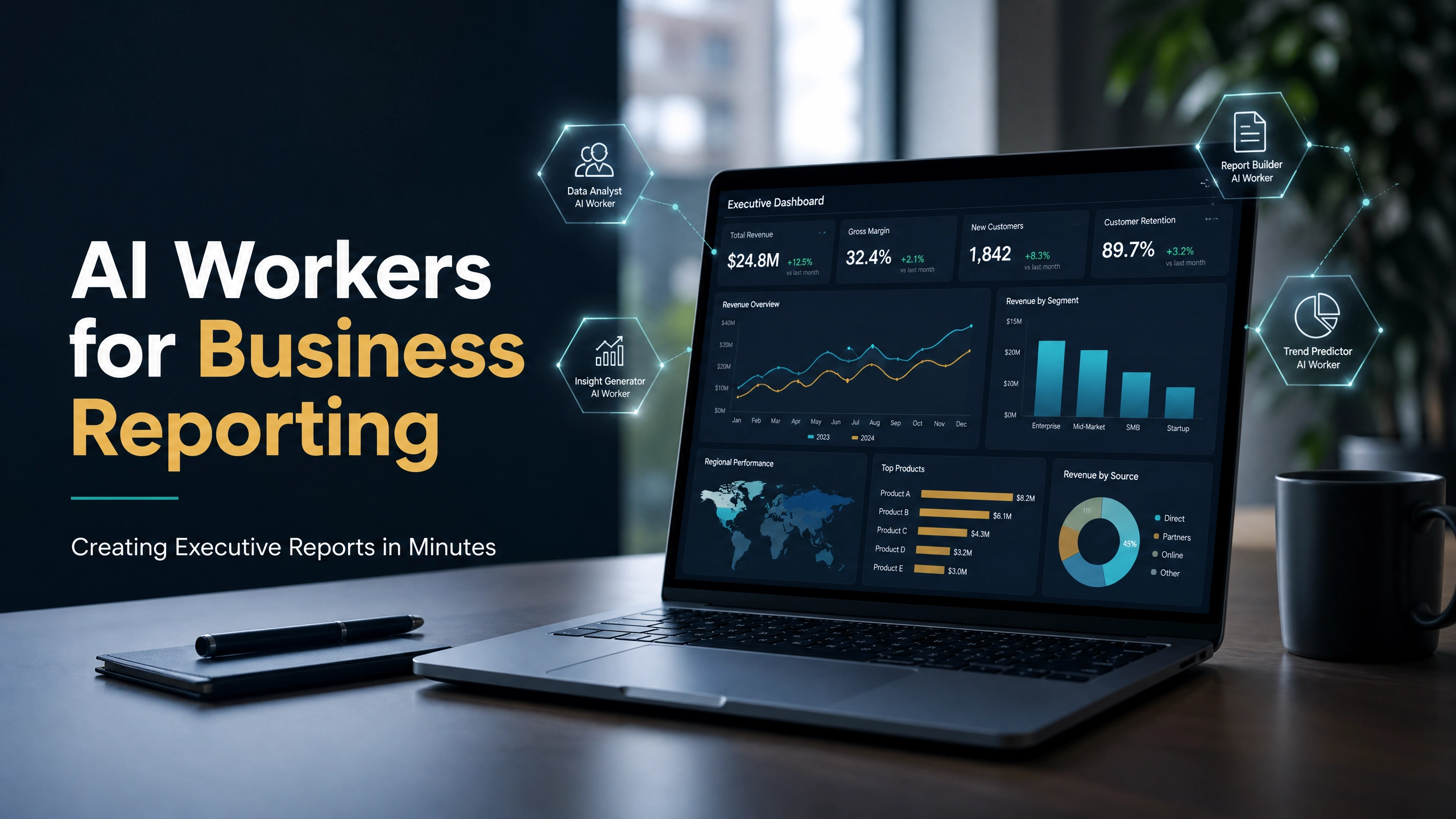
Discover how AI Workers for Business Reporting help organizations create executive-ready reports in minutes. Learn how Saras Reports automates data collection, analysis, and reporting so leaders can make faster, data-driven decisions.
Key Takeaways
- AI Workers for Business Reporting automate data collection, analysis, and executive report generation, reducing the time spent on manual reporting.
- Organizations can create leadership-ready reports in minutes instead of spending hours compiling information from multiple systems.
- AI-powered reporting improves visibility, consistency, and decision-making across finance, sales, marketing, and operations.
- Saras Reports helps businesses automate reporting workflows, monitor KPIs, and deliver executive summaries automatically.
- By reducing administrative effort, Saras Reports enables teams to focus on strategy and decision-making rather than report preparation.
Every executive wants faster answers.
They want to know whether revenue is growing, sales teams are hitting targets, marketing campaigns are delivering results, and operational performance is improving. The challenge is that getting those answers often takes far longer than it should.
In many organizations, reporting is still a manual process. Analysts export spreadsheets from different systems. Managers consolidate information from multiple departments. Teams spend hours formatting reports and preparing presentations for leadership meetings.
The frustrating part is that most businesses already have the data they need.
The real problem is turning that data into meaningful insights quickly enough to support decision-making.
This is why AI Workers for Business Reporting are becoming increasingly important.
Rather than relying on people to manually gather information and build reports, AI-powered reporting systems automate the entire workflow. They collect data, analyze performance, generate insights, and create executive-ready reports in a fraction of the time.
Solutions like Saras Reports are helping organizations make this shift by automating reporting workflows and delivering business insights directly to decision-makers.
The result is not simply faster reporting. It is a smarter way to manage business intelligence.
Understanding AI Workers for Reporting
Most reporting challenges do not come from a lack of information.
If anything, organizations have more data than ever before.
The challenge is that data is often spread across multiple systems. Sales teams use CRM platforms. Finance teams rely on accounting software. Marketing departments work across analytics tools, advertising platforms, and dashboards.
Someone has to bring all that information together.
Traditionally, that responsibility falls on analysts and reporting teams.
This is where AI reporting systems create value.
An AI worker is a digital system designed to perform specific business tasks using artificial intelligence. In a reporting environment, it acts as an intelligent assistant that continuously gathers information, organizes data, identifies trends, and generates reports.
Instead of spending hours pulling numbers from different sources, teams can rely on automation to handle much of the reporting process.
AI reporting systems can help with:
- Collecting data from multiple business tools
- Tracking KPIs and performance metrics
- Monitoring trends and anomalies
- Creating executive summaries
- Generating reports automatically
- Delivering reports to stakeholders on schedule
Nobody joins a company excited to spend hours updating spreadsheets. Yet that is still how reporting works in many organizations.
AI changes that by removing repetitive reporting tasks and allowing teams to focus on interpreting insights rather than assembling data.
Why Traditional Business Reporting Creates Challenges
Reporting sounds simple in theory.
Gather the data. Analyze the results. Share the findings.
In reality, it is rarely that straightforward.
Most organizations operate across dozens of systems, each containing a different piece of the business story. Pulling information together often requires coordination between departments, manual validation, and multiple rounds of review.
This is where reporting becomes difficult.
Manual and Time-Consuming Processes
A simple leadership report can involve:
- Exporting data from multiple systems
- Consolidating spreadsheets
- Cleaning and validating information
- Building charts and dashboards
- Writing summaries for stakeholders
These tasks may seem small individually, but together they can consume hours every week.
By the time the report is completed, the information may already be outdated.
Human Error Becomes a Risk
The more manual the process, the greater the opportunity for mistakes.
A missed data update, incorrect formula, or outdated spreadsheet can create reporting inaccuracies that affect business decisions.
Most teams work hard to maintain reporting quality, but manual workflows always introduce risk.
Reporting Becomes Harder to Scale
As businesses grow, reporting demands increase.
More stakeholders request information. More departments generate data. More reports are needed to support decision-making.
Without automation, reporting teams often become bottlenecks without intending to.
How AI Report Generation Works
This is where things start to get interesting.
Most organizations already have the information they need. The challenge is bringing everything together in a way that makes sense.
Platforms like Saras Reports solve this by acting as a central reporting layer across the business.
Once connected to existing systems, the platform continuously gathers information from multiple sources and organizes it into a structured reporting framework.
Instead of waiting for someone to manually compile spreadsheets, the system automatically tracks performance metrics, analyzes trends, and highlights important developments.
For executives, this matters because they rarely need more data.
They need faster access to the right information.
The platform can identify performance changes, uncover emerging opportunities, and surface risks that deserve attention.
From there, it transforms those findings into reports that leaders can actually use.
These may include:
- Executive summaries
- Leadership dashboards
- Business performance reviews
- Financial reporting updates
- Operational reporting packages
Reports can then be distributed automatically to managers, executives, and stakeholders based on predefined schedules.
What this looks like in practice is simple.
Instead of building reports manually, teams review and act on reports that have already been prepared.
Key Reporting Workflows AI Workers Can Automate
One reason organizations are adopting solutions like Saras Reports is the ability to automate reporting across multiple business functions without creating separate workflows for every department.
Executive and Leadership Reporting
Executives need clarity, not complexity.
AI-powered reporting systems can automatically generate leadership dashboards, executive summaries, board reports, and quarterly business reviews that focus on strategic business performance.
Financial and Sales Reporting
Financial visibility is critical for business growth.
Reporting automation can help organizations generate revenue summaries, sales performance reports, budget analyses, and forecasting updates without requiring hours of manual preparation.
Marketing and Operations Reporting
Marketing and operations teams often work with large volumes of performance data.
AI reporting tools help consolidate information from multiple systems and turn it into meaningful reports that support better decision-making.
Project and Portfolio Reporting
Project leaders need visibility into progress, resources, and outcomes.
Reporting automation helps ensure stakeholders always have access to current project information without requiring project managers to spend valuable time creating updates.
Key Features of AI Business Reporting Solutions
Modern reporting platforms offer much more than automated dashboards.
They provide a complete framework for collecting, analyzing, and distributing business insights.
Key capabilities often include:
- Automated data aggregation
- Real-time reporting dashboards
- KPI monitoring and alerts
- Multi-source data integration
- Executive summary generation
- Natural language reporting
- Scheduled report delivery
- Business insight generation
The technology itself is impressive.
What executives care about, however, is the outcome.
Faster visibility. Better decisions. Less time spent waiting for reports.
Business Benefits of AI Workers for Business Reporting
Organizations usually begin looking at reporting automation because they want to improve efficiency.
What they often discover is that the benefits extend much further.
Faster Report Creation
Reports that once required hours or days can be generated within minutes.
This allows decision-makers to access information when it matters most.
Improved Reporting Accuracy
Automation reduces reliance on manual processes, helping organizations improve consistency and reduce reporting errors.
Better Executive Visibility
Leaders gain access to current business insights rather than waiting for scheduled reporting cycles.
Increased Productivity
Teams spend less time gathering information and more time analyzing results.
This is where automation starts to create measurable value.
More Confident Decision-Making
When leaders have access to accurate and timely information, they can respond faster to opportunities and challenges.
A Real-World Example of AI Reporting in Action
Imagine it is Monday morning.
The executive team needs a performance update before noon.
Without automation, someone may spend hours pulling information from CRM systems, marketing dashboards, accounting software, and spreadsheets before creating a presentation.
It is a familiar scenario for many organizations.
Now imagine the same situation using Saras Reports.
The report is already waiting.
The platform has collected the data, analyzed performance, identified key trends, and generated an executive summary automatically.
Instead of spending the morning building reports, the leadership team spends the morning discussing decisions.
That is the difference reporting automation can make.
Common Concerns About AI Reporting
Whenever organizations evaluate AI-powered reporting, a few questions naturally arise.
Can AI-Generated Reports Be Trusted?
Yes, provided the platform is connected to reliable data sources and supported by appropriate review processes.
Automation improves consistency, while human oversight ensures strategic decisions remain aligned with business goals.
Is Business Data Secure?
Reporting often involves sensitive information.
Modern platforms such as Saras Reports are designed to support secure integrations, access controls, and governance requirements.
Is Implementation Difficult?
This is where many organizations are pleasantly surprised.
Most modern reporting solutions are built to integrate with existing systems, reducing the complexity traditionally associated with reporting automation projects.
Why Businesses Are Adopting AI Reporting Tools
Business leaders face increasing pressure to make decisions quickly.
At the same time, organizations are generating larger volumes of data than ever before.
Traditional reporting methods struggle to keep pace with these demands.
AI-powered reporting provides a practical solution by reducing manual work while improving access to business insights.
For many organizations, the question is no longer whether reporting should be automated.
The question is how quickly they can begin benefiting from it.
Why Saras Reports Stands Out
Organizations looking to modernize reporting need more than another dashboard.
They need a solution that simplifies the entire reporting process.
Saras Reports is designed specifically to help businesses automate reporting workflows from end to end.
The platform helps organizations:
- Consolidate data from multiple business systems
- Monitor KPIs automatically
- Generate executive summaries
- Create leadership-ready reports
- Schedule report delivery
- Improve visibility into business performance
The result is not simply faster reporting.
It is a reporting process that becomes easier to scale as the business grows.
For executives, managers, and analysts, Saras Reports helps eliminate much of the manual work associated with reporting while improving access to timely business insights.
How Saras Reports Helps Businesses Create Executive Reports in Minutes
After understanding the challenges of traditional reporting, the next question is simple:
How can organizations actually automate the process?
This is where Saras Reports comes in.
Saras Reports is an AI worker designed specifically for business reporting and executive reporting automation. Instead of requiring teams to manually collect data, consolidate spreadsheets, analyze performance metrics, and build presentations, Saras Reports automates much of the workflow from start to finish.
The platform acts as a centralized reporting layer that connects to business systems, gathers information automatically, generates insights, and transforms data into executive-ready reports.
For many organizations, this means significantly reducing the time spent preparing reports while improving visibility into business performance.
Key Capabilities of Saras Reports
Saras Reports helps organizations streamline reporting through capabilities such as:
- Automated data collection from connected business systems
- KPI monitoring and performance tracking
- Executive summary generation
- Leadership dashboard creation
- Automated report scheduling and distribution
- Business insight generation and trend analysis
- Cross-department reporting visibility
Instead of building reports manually each week or month, teams can rely on Saras Reports to continuously monitor business performance and deliver reporting automatically.
How Saras Reports Supports Different Teams
For Executives:
Executives gain faster access to business insights without waiting for reporting cycles to be completed.
For Managers:
Managers can monitor team performance, track KPIs, and identify issues before they become larger business challenges.
For Analysts:
Analysts spend less time gathering and formatting data and more time performing strategic analysis.
For Business Leaders:
Leadership teams receive consistent, accurate, and timely reports that support data-driven decision-making.
Business Outcomes Organizations Can Expect
Organizations that automate reporting with Saras Reports can benefit from:
- Faster reporting cycles
- Reduced manual reporting effort
- Improved reporting consistency
- Better executive visibility
- More informed decision-making
- Scalable reporting operations
- Increased productivity across reporting teams
Most importantly, Saras Reports helps organizations shift their focus from creating reports to acting on the insights those reports provide.
The Future of AI Workers for Business Reporting
Reporting is evolving beyond historical analysis.
The next generation of AI reporting systems will not simply explain what happened. They will help organizations understand what is likely to happen next.
Predictive reporting, real-time executive intelligence, conversational reporting interfaces, and AI-powered recommendations are already beginning to reshape how businesses use information.
Organizations that embrace reporting automation today will be better positioned to take advantage of these advances tomorrow.
FAQs
What Are AI Workers for Business Reporting?
AI Workers for Business Reporting are AI-powered systems that automate the process of collecting, analyzing, and reporting business data. They help organizations transform information from multiple sources into actionable insights and executive-ready reports, reducing the time and effort required for manual reporting.
How Do AI Reporting Tools Create Executive Reports?
AI reporting tools connect to business systems such as CRM platforms, accounting software, ERP systems, and analytics tools. They automatically gather relevant data, analyze performance metrics, identify trends and anomalies, and generate structured reports that help executives make informed decisions faster.
What Types of Reports Can AI Workers Automate?
AI workers can automate a wide range of business reports, including executive summaries, financial performance reports, sales reports, marketing analytics reports, operational dashboards, project status updates, KPI reports, and board-level reporting. This enables organizations to maintain consistent reporting across departments while reducing manual effort.
Can AI Reporting Tools Integrate With Existing Business Systems?
Yes. Most modern AI reporting solutions are designed to integrate seamlessly with existing business applications, including CRM systems, accounting platforms, ERP software, marketing tools, customer support platforms, and business intelligence solutions. This allows organizations to centralize reporting without disrupting existing workflows.
What Are the Benefits of Automating Executive Reporting?
Automating executive reporting helps organizations save time, improve reporting accuracy, increase visibility into business performance, and deliver insights more quickly to decision-makers. It also reduces repetitive administrative work, allowing teams to focus on analysis, strategy, and business growth.
How Does Saras Reports Support Reporting Automation?
Saras Reports is an AI-powered reporting solution that helps organizations automate data collection, KPI monitoring, performance analysis, executive summary generation, and report distribution. By streamlining the reporting process from end to end, Saras Reports enables businesses to create accurate, executive-ready reports in minutes rather than hours or days.
Conclusion
Business reporting is not becoming less important. If anything, leaders are being asked to make more decisions with more data than ever before.
The challenge is that traditional reporting processes were never designed for that level of speed and complexity.
Manual workflows, disconnected systems, and growing reporting demands make it difficult for organizations to deliver timely insights consistently.
Solutions like Saras Reports help close that gap.
By automating data collection, analysis, report generation, and report distribution, organizations can create executive-ready reports in minutes instead of spending hours building them manually.
For businesses that want faster visibility, better decision-making, and a reporting process that can scale with growth, Saras Reports provides a practical path forward.
The opportunity is no longer just improving reporting.
It is transforming how reporting gets done.