
We analyzed over 1,000 occupations through the lens of interpersonal intelligence, complex judgment, and physical dexterity to identify the core human abilities that remain the most resistant to AI intervention.
Key Findings
- The “Human Premium” Pillars: Social coordination, complex judgment, and high-dexterity physical interaction are the three primary barriers to AI automation.
- Top Resilient Occupations: Roles in emergency services (Firefighters, Emergency Medicine Physicians) and specialized healthcare (Registered Nurses, Prosthodontists) lead the index.
- The Coordination Advantage: The future of work will reward “human coordination skills”—the ability to navigate complex social dynamics and emotional contexts—more than technical execution.
- The Resilience Matrix: We have identified a “Fortress” of occupations with low AI exposure and high human skill requirements, representing the most stable roles in the coming decade.
Artificial intelligence is transforming industries at an unprecedented speed. From coding assistants to AI-generated content and autonomous systems, machines are increasingly capable of handling tasks once considered uniquely human.
But amid the rapid rise of AI, one critical question remains:
What human skills are still difficult for AI to replicate?
To answer the question, Aiwork, a workplace of AI apps, conducted the Human Skills Index 2026 study. Using occupational data from O*NET and the U.S. Department of Labor, the research analyzed more than 1,000 occupations to identify the abilities that remain most resistant to automation and AI disruption.
The findings reveal a powerful shift in the future of work: the careers most resilient to AI are not necessarily the most technical. Instead, they are the roles built around empathy, judgment, coordination, creativity, and physical adaptability.
Recommended For You: AI Exposure Index: Which Jobs Are Most Exposed to AI and Why
Research Question
Which human abilities remain the least replicable by AI systems, and how do these abilities define the “Human Premium” in the modern workforce?
This study examines:
- Interpersonal & Social Intelligence: Skills like negotiation, persuasion, and emotional empathy.
- Complex Judgment: The ability to make high-stakes decisions in unpredictable, non-binary environments.
- Physical & Spatial Intelligence: The “Hardware Gap”—tasks requiring manual dexterity and gross body coordination in the physical world.
Methodology: The Human Resilience Framework
The Human Skills Index (HSI) is a composite metric derived from the importance of specific AI-resistant elements in the O*NET database.
The Three Pillars of Human Resilience
| Pillar | Core O*NET Elements | Why AI Struggles |
| Social Coordination | Social Perceptiveness, Negotiation, Team Building, Caring for Others | Requires genuine empathy and navigation of complex social hierarchies. |
| Complex Judgment | Originality, Problem Sensitivity, Thinking Creatively, High-Stakes Decision Making | AI excels at optimization but struggles with “first-principles” creativity and ethics. |
| Physical Dexterity | Manual Dexterity, Finger Dexterity, Spatial Orientation, Gross Body Coordination | The “Moravec’s Paradox”—high-level reasoning is easy for AI, but low-level sensorimotor skills are hard. |
Index Calculation
The HSI is calculated by averaging the importance scores of these elements across all occupations and normalizing the result to a 0–100 scale.
What Is the Human Skills Index?
The Human Skills Index (HSI) is a composite framework designed to measure how dependent occupations are on uniquely human capabilities. Rather than focusing on what AI can automate, the study focuses on the opposite:
The abilities AI still struggles to reproduce effectively.
The study identifies three core pillars of AI-resistant human capability:
- Social Coordination
- Complex Judgment
- Physical Dexterity
Together, these pillars form what the research team calls the “Human Premium” — the set of human abilities likely to retain long-term value in an AI-driven economy.
The Three Human Skills AI Still Struggles With
The study found three human skills that are most resistant to AI.
1. Social Coordination
One of the strongest barriers to automation is the ability to navigate human relationships and social complexity.
According to the study, skills such as:
- Negotiation
- Team building
- Emotional intelligence
- Social perceptiveness
- Caring for others
…remain extremely difficult for AI systems to replicate effectively.
While AI can simulate conversation and generate responses, it still lacks genuine empathy, contextual awareness, emotional nuance, and trust-building capability.
This is why leadership roles, healthcare professionals, educators, and emergency responders continue to rank highly in human resilience.
We call this emerging advantage the “Coordination Advantage” — the growing economic value of people who can manage systems, relationships, and human dynamics under pressure.
2. Complex Judgment
AI excels at optimization, prediction, and pattern recognition. However, from the study, we found that machines still struggle with:
- Ethical decision-making
- Creative problem-solving
- First-principles reasoning
- High-stakes judgment
- Unpredictable environments
These capabilities form the second pillar of AI resistance: Complex Judgment.
Human workers frequently make decisions in ambiguous situations where there is no perfect dataset, no historical precedent, and no single correct answer.
This is especially important in fields like:
- Emergency medicine
- Executive leadership
- Law enforcement
- Surgery
- Strategic management
In these environments, the cost of poor judgment is often extremely high, making human oversight essential.
3. Physical Dexterity
One of the most overlooked findings in AI discussions is that physical adaptability remains surprisingly difficult to automate.
The report highlights what is often referred to as Moravec’s Paradox: high-level reasoning may be easier for AI than low-level sensorimotor coordination.
Tasks requiring:
- Fine motor skills
- Spatial awareness
- Body coordination
- Real-world adaptability
- Dexterous physical interaction
continue to resist full automation.
This helps explain why occupations involving complex physical environments still score highly on the Human Skills Index.
The Most AI-Resistant Occupations in 2026
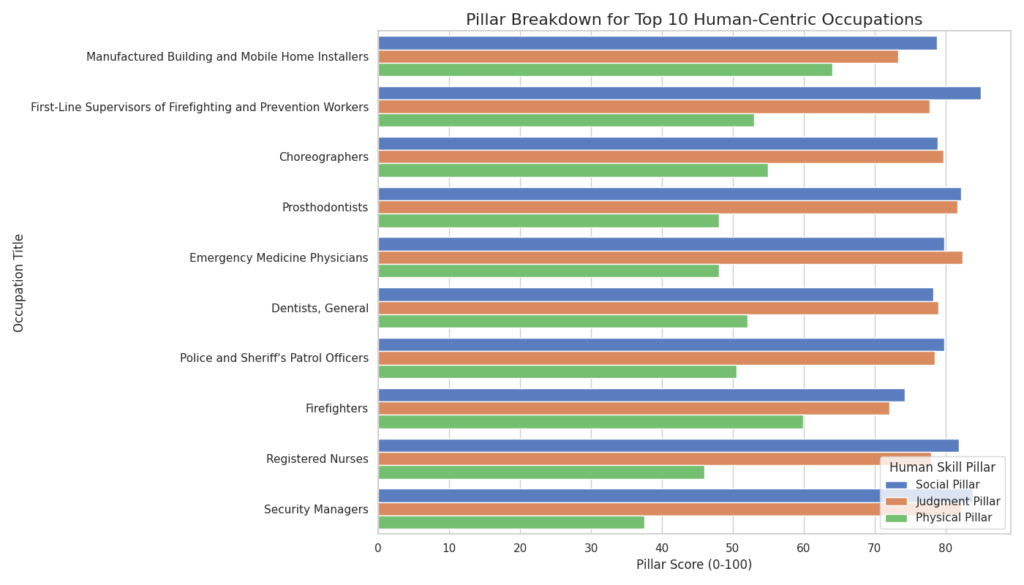
We ranked the occupations most resistant to AI and found a consistent pattern: the most resilient occupations combine all three pillars of human capability.
Here are the top 10 human occupations most resistant to AI:
- Manufactured Building and Mobile Home Installers
- First-Line Supervisors of Firefighting and Prevention Workers
- Choreographers
- Prosthodontists
- Emergency Medicine Physicians
- Dentists
- Police Officers
- Firefighters
- Registered Nurses
- Security Managers
Free Download: 850+ Human Occupations Most Resistant to AI
These professions require workers to simultaneously manage human interaction, physical complexity, and critical decision-making.
For example:
- Firefighters operate in unpredictable physical environments while coordinating teams and making life-or-death decisions.
- Registered nurses combine emotional care, technical judgment, and hands-on physical work.
- Prosthodontists require precision dexterity alongside patient communication and problem-solving.
Human presence in these occupations is not simply helpful, it is structurally necessary.
The Human Skills “Fortress”
To identify a “Fortress” of occupations with low AI exposure and high human skill requirements, the research team developed the Resilience Matrix, which maps AI exposure against human skill intensity.
This helped us categorize the workforce into four distinct quadrants.
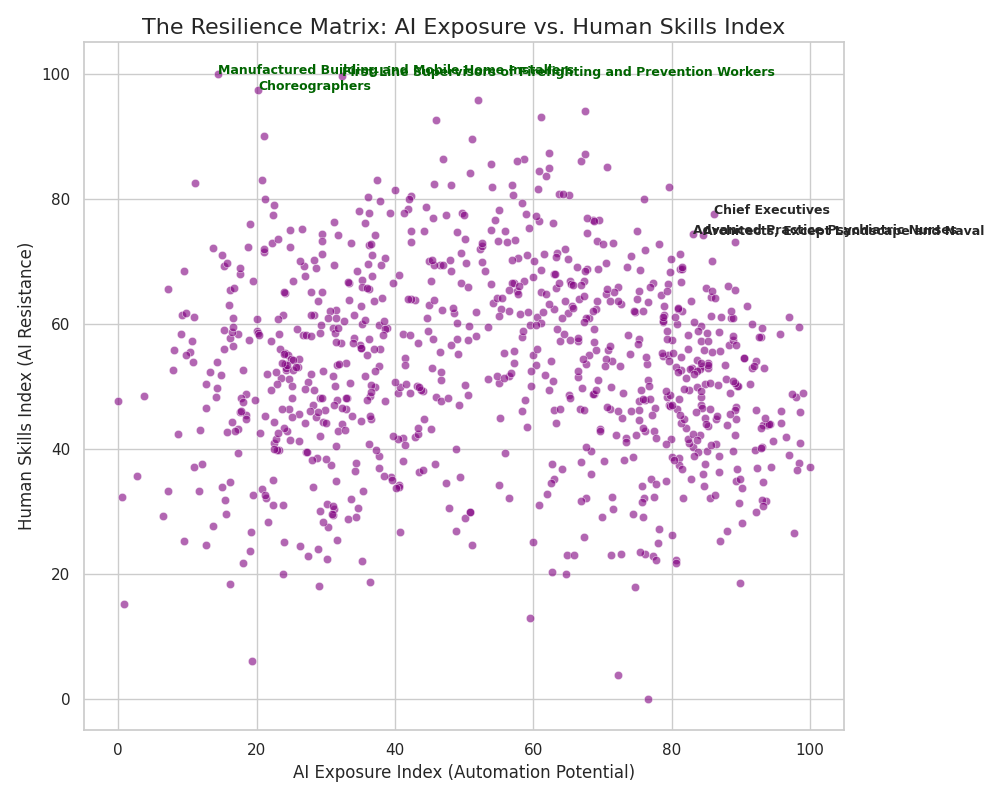
- The Fortress (Bottom-Left): Low AI Exposure, High Human Skills.
- The Augmentation Sweet Spot (Top-Left): High AI Exposure, High Human Skills.
The most protected category is called:
The Fortress
These are occupations with:
- Low AI exposure
- High human skill requirements
Examples include:
- Registered nurses
- Firefighters
- Emergency medical professionals
These jobs remain difficult to automate because they depend heavily on social coordination, physical adaptability, and real-time judgment simultaneously.
The Augmentation Sweet Spot
These roles will be heavily augmented by AI, but the “Human-in-the-loop” remains critical for final judgment and social coordination.
These occupations have:
- High AI exposure
- High human skill dependency
Examples include executives, surgeons, and administrators.
In these roles, AI will increasingly assist with analysis, automation, and operational efficiency. However, human oversight remains essential for:
- Strategic direction
- Ethical decisions
- Communication
- Relationship management
- Final judgment
Rather than replacing workers entirely, AI is more likely to augment them.
Why Human Coordination May Become the Most Valuable Skill
We believe that the future of work may shift away from pure technical execution.
As AI automates more repetitive cognitive tasks like:
- Data analysis
- Drafting
- Coding assistance
- Administrative processing
The economic value of workers may increasingly depend on their ability to coordinate people and systems. Future competitive advantage will come from:
- Building trust
- Resolving conflicts
- Leading teams
- Managing uncertainty
- Creating strategic vision
In other words, deeply human capabilities may become more important, not less.
Actionable Skills Workers Should Develop
The Human Skills Index outlines several practical recommendations for professionals preparing for an AI-driven workforce.
- Double Down on Empathy: Roles involving high social interaction will increasingly reward emotional intelligence and interpersonal awareness.
- Develop Systemic Judgment: Workers who can understand complex systems, weigh trade-offs, and make ethical decisions will remain highly valuable.
- Build Physical Versatility: In hands-on professions, adaptability and broad physical skillsets create stronger resilience against robotics and automation.
Final Thoughts On Human Skills Most Resistant to AI
The biggest insight from The Human Skills Index 2026 is surprisingly optimistic.
The future of work is not simply about competing against machines. It is about strengthening the abilities that make humans uniquely valuable.
AI may continue to outperform humans in speed, scale, and data processing. But empathy, judgment, creativity, coordination, and physical adaptability remain far harder to replicate.
The careers most resistant to AI are not necessarily the most technical. They are the ones built around the deeply human skills machines still cannot fully master.
The future of work is not a race against the machine, but a return to the core of what makes us human.
