
Our AI Exposure Index 2026 delivers a data-driven analysis of how artificial intelligence is reshaping the workforce, revealing which roles are most exposed and where productivity gains will emerge.
Key Takeaways
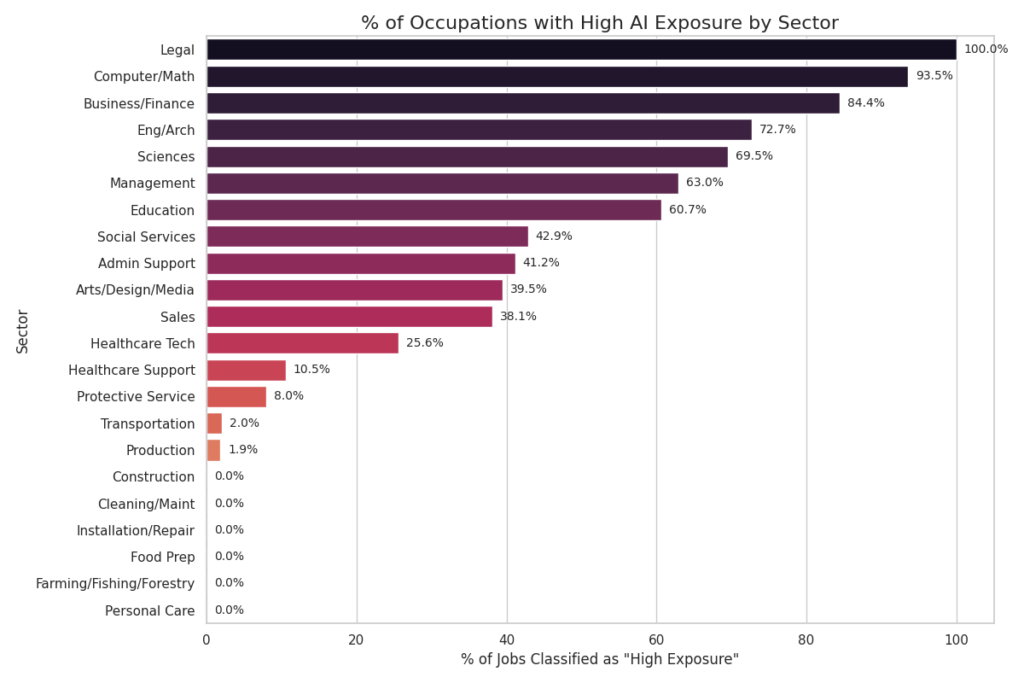
- Sector Vulnerability: 100% of Legal occupations and 93.5% of Computer/Mathematical roles are classified as “High Exposure.”
- Overall Impact: 34.1% of all jobs in the dataset fall into the “High Exposure” category, where cognitive tasks dominate daily workflows.
- Physical Resilience: Construction, Farming, and Food Preparation sectors show 0% “High Exposure” jobs, highlighting the current limits of AI in physical and unpredictable environments.
- Core Activity Intensity: “Getting Information” is the most intense AI-exposed work activity, with an average importance score of 4.22 out of 5 across all occupations.
As AI systems transition from experimental tools to operational infrastructure, the need to precisely measure their real-world impact has become increasingly critical. To address this, the team at Aiwork, a suite of AI Professionals for Investors and Businesses, conducted a comprehensive study to understand how artificial intelligence is reshaping jobs at a structural level.
The result is the AI Exposure Index (AEI), a composite metric ranging from 0 to 100 that quantifies how susceptible an occupation’s core tasks and abilities are to AI-driven augmentation or automation.
Drawing on detailed task-level data from O*NET, the study maps the “surface area” for AI intervention across 22 occupational sectors and hundreds of individual roles. Rather than focusing on job titles alone, it provides a structured, data-driven view of where AI is most likely to transform how work is performed.
Explore the full report to discover where your job sits on the AI Exposure Index and what it means for your future productivity and career trajectory.
Research Question
The study seeks to understand how the exposure of occupations to artificial intelligence can be measured at the task and ability level, and what structural factors drive differences in this exposure across industries.
To address this, the analysis explores:
- Which cognitive abilities and work activities create the largest surface area for AI intervention across the workforce?
- Examines how the density and structure of tasks within an occupation influence its overall AI Exposure Index (AEI).
- Evaluates the proportion of the workforce operating in high-exposure roles where AI-driven productivity gains are most likely to emerge.
The research shifts the focus away from job titles and toward the underlying structure of work. It examines how the composition of tasks and required abilities, rather than the name of a role, determines its exposure to AI-driven transformation.
Research Methodology
The primary data source for this study is the O*Net 30.2 Database and the U.S. Department of Labor, Employment and Training Administration. No changes were made to the original dataset.
Occupational Information Network (O*NET) is a comprehensive U.S. database that provides detailed, standardized descriptions of occupations, including their required skills, knowledge, abilities, and tasks.
The study applies a multi-layered analytical framework based on the ONET Content Model (2023–2024). All analysis was conducted using Python, leveraging libraries such as Pandas and NumPy on the ONET database.
The methodology is divided into three core phases:
Element Classification (AI-Exposed vs. AI-Resilient)
We identified 52 Abilities and 41 Work Activities, categorizing them based on their susceptibility to current and near-term AI capabilities (e.g., LLMs, Computer Vision, and Pattern Recognition).
- AI-Exposed (Cognitive/Information): Deductive Reasoning, Mathematical Reasoning, Analyzing Data, Processing Information, Interacting with Computers.
- AI-Resilient (Physical/Interpersonal): Manual Dexterity, Gross Body Coordination, Assisting and Caring for Others, Performing General Physical Activities.
The AI Exposure Index (AEI) Formula
For each occupation, we calculated a composite score based on the Importance of these elements. The raw exposure score and resilience score are defined as:
- Exposure Score: The average importance of all AI-exposed elements.
- Resilience Score: The average importance of all AI-resilient elements.
The final AI Exposure Index (AEI) is the normalized difference between these two scores, scaled from 0 to 100:
Impact Stratification
Occupations were stratified into three tiers based on their AEI percentiles:
- High Exposure (Top 33%): AEI > 66. Roles where AI can optimize or automate more than 50% of core cognitive workflows.
- Medium Exposure (Middle 33%): AEI 33–66. Hybrid roles with mixed physical and cognitive demands.
- Low Exposure (Bottom 33%): AEI < 33. Roles primarily resilient to software-based AI due to physical or complex human interaction requirements.
AI Exposure Sector Analysis
The impact of AI is highly concentrated in information-dense sectors. Our analysis categorized jobs into “Low,” “Medium,” and “High” exposure based on their AEI scores.
The High-Exposure Frontline
The table below shows the top 5 sectors with the highest percentage of “High Exposure” jobs.
| Sector | Avg. AI Exposure Index | % High Exposure Jobs | Key Exposed Activity |
| Legal | 88.3 | 100.0% | Documenting/Recording Information |
| Computer/Math | 86.0 | 93.5% | Interacting With Computers |
| Business/Finance | 81.3 | 84.4% | Analyzing Data or Information |
| Eng/Arch | 76.2 | 72.7% | Processing Information |
| Sciences | 77.7 | 69.5% | Updating and Using Knowledge |
The Resilience Shield
Conversely, sectors requiring physical dexterity, spatial reasoning, and real-time physical problem-solving show zero “High Exposure” jobs. These include Construction, Farming/Fishing/Forestry, and Food Preparation.
Top Exposed vs. Most Resilient Occupations
A closer look at specific job titles reveals the stark contrast in AI exposure.
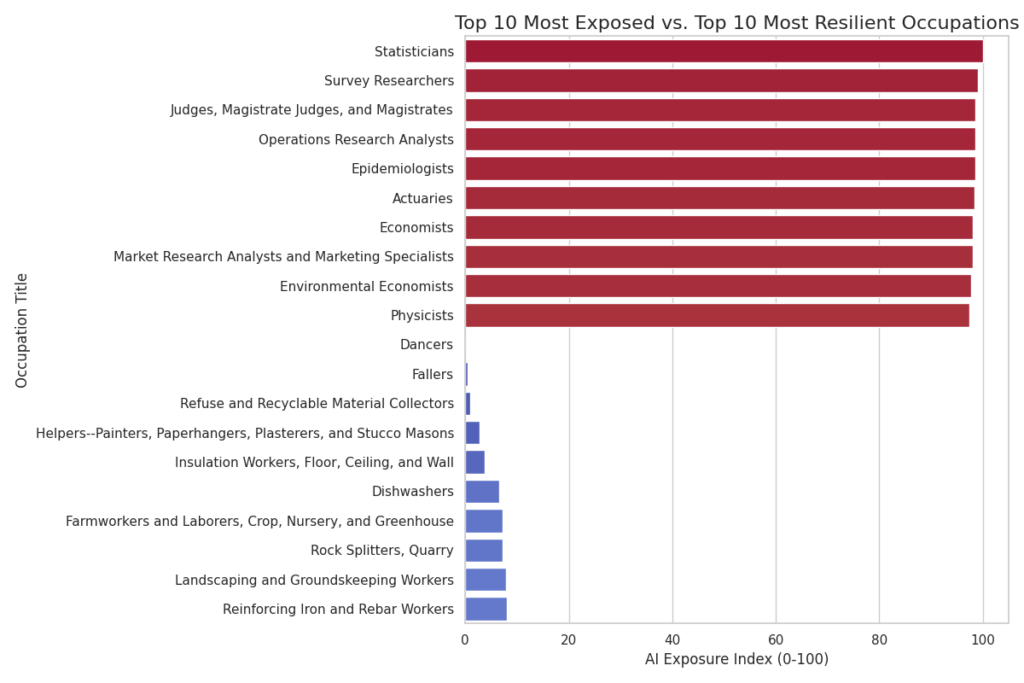
- High Exposure: Statisticians, Economists, and Judges score highest. These roles involve complex data analysis and information synthesis, tasks where Large Language Models and specialized AI systems excel.
- High Resilience: Dancers, Fallers (logging), and Refuse Collectors are among the least exposed. These roles require high physical coordination and operate in unpredictable physical environments.
Top 10 Most Exposed Occupations
To provide a more relatable view, we have identified the top 10 occupations with the highest AI Exposure Index scores. These roles represent the “ground zero” for AI-driven workflow transformation.
| Rank | Occupation Title | AI Exposure Index |
| 1 | Statisticians | 100.0 |
| 2 | Survey Researchers | 99.0 |
| 3 | Judges, Magistrate Judges, and Magistrates | 98.6 |
| 4 | Operations Research Analysts | 98.6 |
| 5 | Epidemiologists | 98.5 |
| 6 | Actuaries | 98.4 |
| 7 | Economists | 98.2 |
| 8 | Market Research Analysts and Marketing Specialists | 98.0 |
| 9 | Environmental Economists | 97.7 |
| 10 | Physicists | 97.4 |
These occupations are characterized by a high density of structured cognitive tasks, making them the primary beneficiaries of AI-driven productivity gains.
Key Insights
- The Logic Premium: Occupations like Mathematicians and Statisticians score highest because their work is governed by strict logical rules. AI systems (especially specialized neural networks) are exceptionally efficient at navigating these rule-based environments.
- The Synthesis Surge: Judges and Sociologists represent a new frontier of AI exposure. Their work involves synthesizing vast amounts of unstructured text into structured conclusions, a task that Large Language Models (LLMs) have now mastered.
- High Skill is Not Equal Low Exposure: These are all high-education, high-salary roles. AI exposure is not a measure of “easiness,” but of structural clarity. These jobs aren’t exposed because they are “easy,” but because they are “structured,” which is exactly what AI thrives on.
Proportion of the Workforce in High-Exposure Roles
Our study reveals that a substantial portion of the workforce is currently operating in roles highly susceptible to AI-driven productivity gains.
Approximately 34.1% of all occupations in the O*NET database are classified as “High Exposure,” meaning their AI Exposure Index (AEI) falls within the top third of all scores.
Overall Distribution of Impact
Across the entire dataset of over 1,000 occupations, the distribution of AI exposure is as follows:
- High Exposure (34.1%): Roles where AI can augment or automate a significant portion of core cognitive tasks.
- Medium Exposure (33.3%): Roles with a mix of cognitive and physical/interpersonal tasks.
- Low Exposure (32.6%): Roles primarily driven by physical labor or complex human interaction.
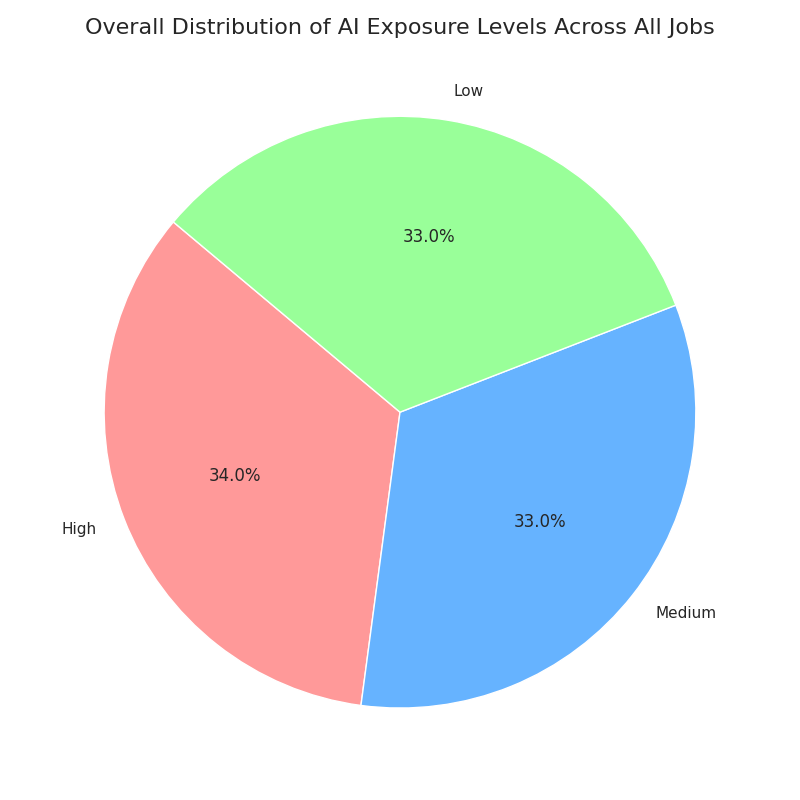
This proportion highlights the widespread potential for AI to reshape daily work across various sectors.
These high-exposure roles are predominantly found in sectors like Legal (100% of jobs classified as High Exposure) and Computer/Mathematical (93.5% of jobs classified as High Exposure), where information processing and cognitive tasks form the core of daily responsibilities.
The prevalence of these roles underscores the urgency for strategic adaptation, focusing on AI literacy and human-AI collaboration to maximize productivity and foster workforce resilience.
Structural Drivers of AI Exposure
The study delved into the specific characteristics of occupations that drive their susceptibility to AI intervention, providing quantitative answers to key questions regarding the nature of AI’s impact on work.
Here are what we found:
Cognitive Abilities and Work Activities Driving AI Intervention
AI’s most significant “surface area” for intervention lies within cognitive and information-processing tasks.
Our analysis reveals that activities requiring systematic information handling and knowledge application are consistently rated as highly important across occupations, making them prime targets for AI augmentation.
Key AI-Exposed Work Activities (Average Importance Score out of 5):
| Work Activity | Average Importance |
| Getting Information | 4.22 |
| Updating and Using Relevant Knowledge | 3.78 |
| Organizing, Planning, and Prioritizing Work | 3.70 |
| Documenting/Recording Information | 3.64 |
| Processing Information | 3.63 |
| Analyzing Data or Information | 3.43 |
| Scheduling Work and Activities | 3.18 |
These activities, particularly “Getting Information” (average importance of 4.22), represent the foundational elements where AI can provide immediate leverage by automating data retrieval, synthesis, and preliminary analysis.
Similarly, AI-exposed cognitive abilities such as Deductive Reasoning, Mathematical Reasoning, and Written Comprehension are critical for tasks that AI excels at, such as pattern recognition, logical inference, and content generation.
To understand why certain jobs are exposed, we analyzed the importance of core “AI-exposed” work activities for some of the most exposed occupations.
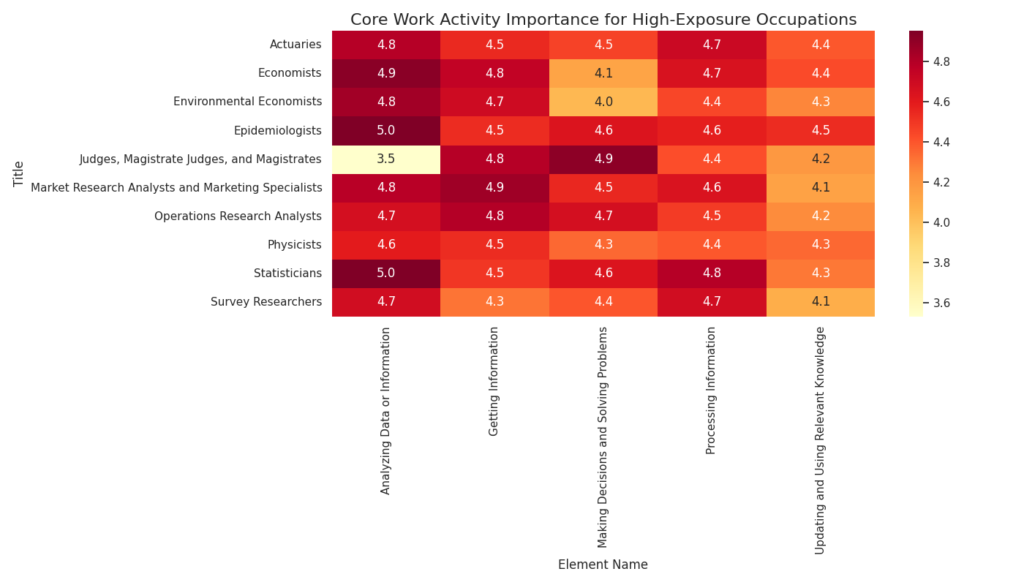
The heatmap illustrates that for high-exposure roles, activities like Analyzing Data and Interacting with Computers are consistently rated as highly important (often 4.5+ on a 5-point scale). These activities are the primary targets for AI-driven productivity gains.
Task Density and Structure as Predictors of AI Exposure
The density and structure of tasks within an occupation significantly influence its overall AI Exposure Index (AEI). Our analysis confirms a positive correlation of approximately 0.125 between the total number of defined tasks in an occupation and its AI Exposure Index.
While not a perfect linear relationship, this indicates that jobs with a higher volume of discrete, well-defined tasks tend to have a greater potential for AI intervention.
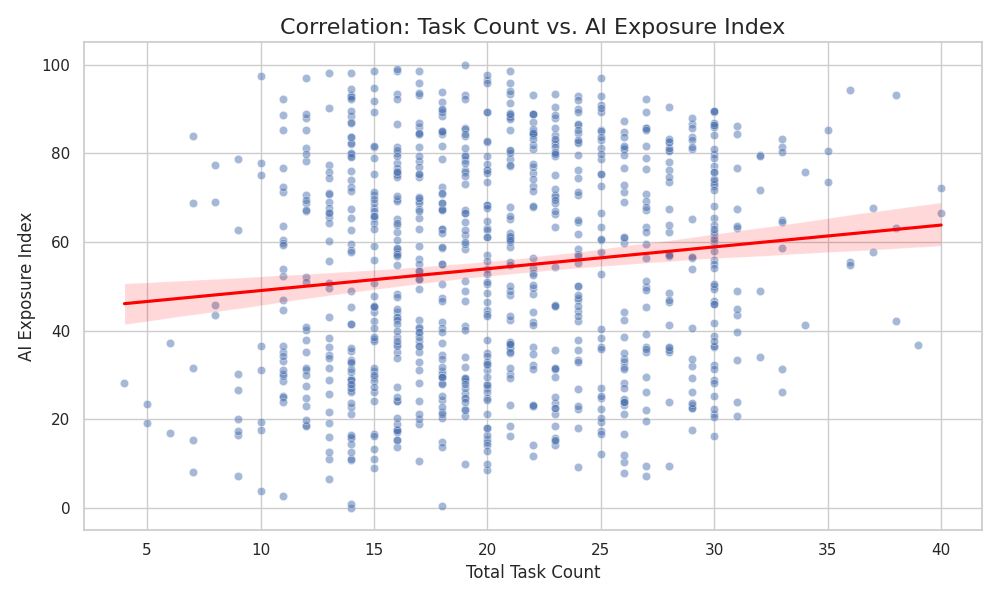
This correlation suggests that occupations characterized by highly structured workflows and clearly delineated task lists offer more opportunities for AI to optimize, automate, or assist.
Each additional structured task represents another point of potential integration for AI tools, leading to higher overall exposure.
Strategic Implications for the AI-Driven Workforce
For Workers: The Shift to AI Leverage
The most valuable skill in an AI-exposed role is no longer the execution of the task itself, but the ability to supervise and leverage AI to perform those tasks. Workers should focus on “Human-in-the-loop” workflows where they provide the final judgment and strategic direction.
For Companies: Operational Optimization
Organizations should map their internal workflows to these task-level insights. High-exposure roles represent the greatest opportunity for immediate ROI through AI integration, while low-exposure roles require continued investment in human talent and physical safety.
For Policymakers: Targeted Upskilling
Education and training programs should be tailored to the specific needs of each sector. While high-exposure sectors need “AI literacy,” resilient sectors may need more investment in vocational training and physical ergonomics.
Action Framework: How to Respond to AI Exposure Across Roles
For High-Exposure Occupations (AEI > 66)
- Recommendation: Focus on “AI Orchestration.”
- Actionable Step: Transition from “doing” tasks (e.g., data entry, basic analysis) to “validating” and “directing” AI outputs. Invest in training for AI prompting and oversight.
- Quantified Target: Aim to reduce time spent on “Getting Information” (Avg. Importance 4.22) by 50% through AI-driven search and synthesis tools.
For Medium-Exposure Occupations (AEI 33–66)
- Recommendation: Hybrid Skill Development.
- Actionable Step: Identify the specific “cognitive islands” within the job (e.g., scheduling, documentation) and automate them to free up time for high-value human interactions.
- Quantified Target: Target the 3.6/5 importance activities like “Documenting/Recording Information” for immediate automation.
For Low-Exposure Occupations (AEI < 33)
- Recommendation: Strategic Physical Augmentation.
- Actionable Step: While these roles are resilient to software AI, they may be impacted by robotics. Focus on enhancing human dexterity and safety through assistive technologies.
- Quantified Target: Maintain the 0% “High Exposure” status by doubling down on skills like “Manual Dexterity” and “Interpersonal Coordination.”
Final Thoughts: From Exposure to Leverage
The AI Exposure Index 2026 provides a definitive answer to how Artificial Intelligence is reshaping the modern workforce. By shifting the focus from job titles to the underlying task-level architecture, this study reveals that AI impact is a function of structural design rather than general intelligence.
Our analysis has provided clear, data-driven answers to the study’s core inquiries:
- The Surface Area of Intervention: We have identified that the largest “surface area” for AI intervention lies in information-dense work activities, most notably “Getting Information” and “Analyzing Data,” which serve as the primary cognitive engines of high-exposure roles.
- The Role of Task Density: Our analysis confirms that task density and structure are leading indicators of AI exposure. Occupations with highly structured, discrete task lists provide the most fertile ground for AI integration, optimization, and productivity gains.
- The Workforce at a Crossroads: With 34.1% of the workforce operating in “High Exposure” roles, the potential for AI-driven transformation is no longer a future projection but a present reality. This concentration in sectors like Legal and Computer/Mathematical services marks the frontline of a new era of cognitive leverage.
This index should not be interpreted as a signal of displacement, but as a clear indicator of where the greatest opportunities for productivity gains exist. Rather than predicting job loss, the study provides a structured lens for understanding how work is being redefined, highlighting where tasks can be accelerated, augmented, and scaled.
The question is no longer whether AI will impact work, but how effectively that impact can be leveraged.
By quantifying exposure at both the sector and job level, this study offers a practical foundation for organizations and individuals to move from reactive concern to proactive adaptation.
