
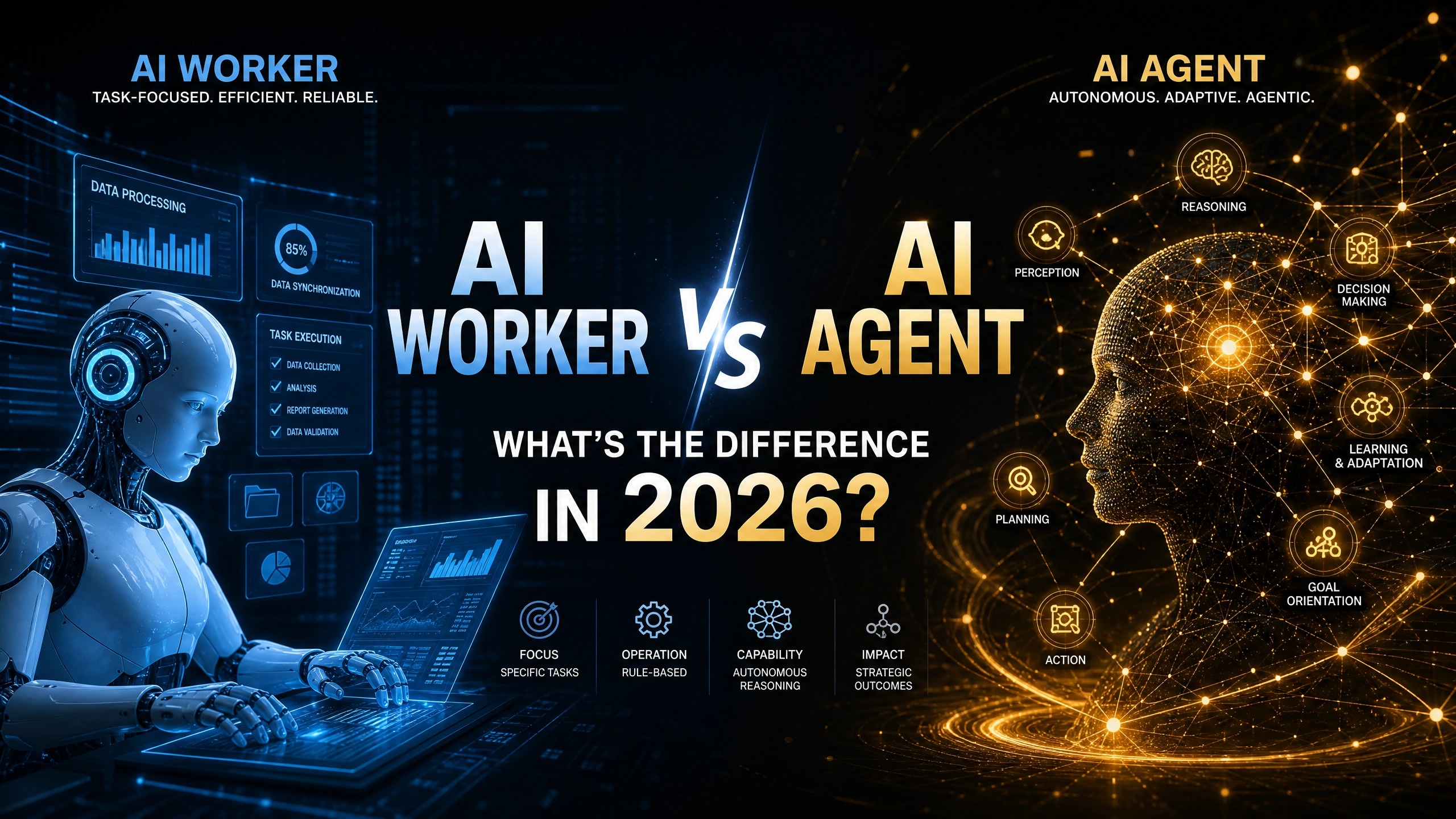
Discover the key differences between AI workers and AI agents in 2026. Learn how businesses use specialized AI workers for finance, recruiting, reporting, customer support, and operational workflows. AI Worker vs AI Agent explained.
Key Takeaways
- AI workers are specialized AI systems designed to support structured business functions such as finance, recruiting, reporting, customer support, and research.
- AI agents are autonomous systems designed to achieve broader goals dynamically, with less predefined workflow structure.
- Businesses are adopting AI workers faster because they are easier to integrate, monitor, manage, and scale across operational teams.
- Platforms like URL Aiwork provide role-specific AI workers built around real professional workflows instead of experimental autonomous behavior.
- The future of AI adoption will likely combine structured AI workers with more advanced autonomous agent systems.
Artificial intelligence is evolving quickly, but many businesses still confuse AI workers with AI agents. While the terms are often used interchangeably, they serve very different purposes inside professional environments.
AI agents are designed around autonomous decision-making and dynamic task execution. AI workers are more structured systems built to support specific operational responsibilities such as research, recruiting, reporting, finance operations, and customer communication.
For a broader overview of how AI workers operate across finance, hiring, research, reporting, and customer support, read our complete guide to AI workers.
As AI adoption moves beyond experimentation, understanding this distinction is becoming increasingly important for businesses evaluating real operational use cases.
Why AI Workers and AI Agents Are Often Confused
The confusion around AI workers and AI agents largely comes from how quickly the AI industry is evolving. Many platforms, marketers, and product teams use the terms interchangeably even though the systems are designed very differently.
Part of the problem is that the broader AI landscape still lacks consistent definitions. As new AI products launch rapidly, terms like “AI agent,” “AI assistant,” and “AI worker” are often used loosely across marketing campaigns and industry discussions.
In some cases, simple automation tools are labeled as AI agents to appear more advanced. In other situations, highly structured AI workers are described as autonomous agents even though they operate within clearly defined workflows and business rules.
For businesses evaluating AI systems, this distinction matters because operational requirements are very different from experimental AI demonstrations.
Most organizations prioritize practical concerns such as reliability, predictability, workflow clarity, security, oversight, and scalability. This is one reason structured AI workers are gaining traction across professional environments where consistency and operational control are critical.
What Is an AI Worker?
An AI worker is a specialized AI system designed to support structured business operations and recurring professional tasks. Unlike traditional chatbots that mainly respond to prompts or conversations, AI workers are built to function inside real workflows where consistency, speed, and operational support matter.
Businesses are increasingly using AI workers to help teams reduce manual coordination, automate repetitive processes, and manage information more efficiently across departments.
AI workers can support:
- investment research and market analysis
- customer support operations
- hiring and recruitment workflows
- finance and accounting tasks
- reporting and documentation
- administrative coordination and workflow management
The goal of an AI worker is not complete autonomy. Instead, AI workers are designed to improve operational efficiency by helping teams execute ongoing responsibilities more effectively while still operating within structured workflows and human oversight.
Platforms like Aiwork provide AI workers built around practical business use cases rather than broad experimental automation. Its ecosystem includes Orion AI for investment research, Hermes AI for market monitoring, Olympus AI for equity simulations, Luca Accounts for finance operations, Freddie HR for recruitment workflows, Saras AI for reporting and documentation, and Yumi AI for customer support.
Each AI worker is designed around a clearly defined professional responsibility. This role-based structure makes it easier for businesses to integrate AI workers across teams while maintaining workflow clarity, operational visibility, and human oversight.
What Is an AI Agent?
An AI agent is an autonomous AI system designed to pursue goals dynamically with minimal human intervention. Unlike structured AI workers that operate within clearly defined workflows, AI agents are built to make decisions, adapt to changing situations, and execute tasks independently.
AI agents can:
- make autonomous decisions
- interact with tools independently
- adapt to changing environments
- coordinate multi-step actions
- modify execution strategies during tasks
In many cases, AI agents function more like autonomous software systems than workflow-oriented business assistants. For example, an AI agent may independently browse the web, gather information, select tools, create execution plans, and adjust its approach in real time based on new inputs or changing conditions.
AI agents are commonly associated with advanced automation systems, coding agents, autonomous experimentation, research orchestration, and multi-agent AI environments. For teams comparing how different agents perform on the same task, an AI agent comparison platform can help evaluate outputs side by side before choosing the right system for a workflow.
While AI agents can be highly flexible and powerful, they are often less predictable than structured AI workers. This is one reason many businesses still prefer AI workers for operational environments where reliability, oversight, and workflow consistency are critical.
AI Worker vs Chatbot
Many people still assume AI workers are simply more advanced versions of chatbots, but the difference is much bigger than conversational ability.
Traditional chatbots are mainly designed to respond to prompts, answer questions, and handle basic interactions. Their role is usually limited to communication.
AI workers are built for operational execution. Instead of only responding conversationally, they are designed to support structured business responsibilities and integrate into broader workflows across departments.
For example:
- Yumi AI supports customer communication workflows beyond simple chatbot interactions
- Saras AI helps teams generate structured reports and documentation
- Freddie HR supports hiring coordination and recruitment management processes
This role-based approach makes AI workers more useful for businesses managing ongoing operational responsibilities rather than isolated conversations.
Unlike traditional chatbots, AI workers are designed around repeatable workflows, business systems, and professional execution. They can support day-to-day operations across finance, recruiting, reporting, customer service, research, and administrative coordination while still operating within structured oversight and workflow boundaries.
AI Worker vs AI Agent: Core Differences
Although AI workers and AI agents are both powered by artificial intelligence, they are designed for very different types of execution inside business environments.
AI workers are built around structured operational responsibilities. They support repeatable workflows, defined business functions, and ongoing team processes.
AI agents are more autonomous and adaptive. They are designed to pursue goals dynamically, make independent decisions, and determine their own execution paths with less predefined structure.
Here’s a simplified comparison:
| Feature | AI Worker | AI Agent |
| Primary Focus | Structured business workflows | Autonomous goal execution |
| Workflow Style | Role-based and task-oriented | Dynamic and adaptive |
| Predictability | More predictable | Variable depending on context |
| Oversight | Human-guided | Often more autonomous |
| Operational Use | Business operations and workflow support | Autonomous task coordination |
| Reliability | More controlled and consistent | More flexible but less predictable |
| Business Readiness | Easier to deploy operationally | Often experimental |
Workflow Structure
AI workers operate within clearly defined responsibilities tied to specific business outcomes.
For example:
- Freddie HR supports recruitment and hiring coordination
- Saras AI focuses on reporting and documentation
- Yumi AI supports customer communication workflows
- Luca Accounts assists with finance operations
Each AI worker is designed around a structured operational role, making it easier for businesses to integrate AI into existing systems and workflows.
AI agents are typically less constrained. Instead of following predefined operational responsibilities, they are designed to adapt dynamically and determine how tasks should be completed based on changing inputs and objectives.
Predictability and Control
One of the biggest differences between AI workers and AI agents is predictability.
AI workers are generally more reliable in operational environments because they function within structured workflow boundaries. This is especially important for areas such as:
- finance operations
- customer support
- recruiting
- reporting
- compliance-sensitive workflows
Businesses usually prioritize consistency, oversight, and operational clarity when deploying AI systems across teams.
AI agents, on the other hand, may behave differently depending on tool access, changing inputs, and autonomous decision-making. While this flexibility can be powerful, it can also introduce unpredictability in professional environments where reliability and accountability are critical.
Autonomy Level
AI agents are generally more autonomous than AI workers. They are designed to make decisions independently, adapt to changing situations, and manage multi-step execution with minimal human guidance.
In many cases, AI agents can:
- make independent decisions
- chain multiple tasks together
- adjust strategies dynamically
- operate across changing environments
This flexibility allows AI agents to handle broader objectives, but it can also introduce unpredictability depending on how the system is configured.
AI workers operate differently. They usually function within more structured workflow boundaries and defined operational responsibilities. This makes their behavior easier to manage, monitor, and align with business processes.
Business Readiness
AI workers are often easier to deploy in professional environments because they are built around operational consistency and workflow clarity.
Most organizations require AI systems that provide:
- structured oversight
- predictable outputs
- accountability
- workflow visibility
- operational consistency
AI workers fit naturally into these requirements because they are designed to support defined business functions rather than operate with unrestricted autonomy.
This is one reason many businesses are currently prioritizing AI workers for finance, recruiting, customer support, reporting, and operational coordination workflows.
Why Businesses Are Adopting AI Workers Faster
Many organizations are adopting AI workers before fully autonomous AI agents because the business value is easier to implement operationally.
Most companies are not looking for unrestricted AI autonomy. They want systems that can improve execution, reduce repetitive workload, and support teams reliably within existing business processes.
Businesses usually prioritize:
- reliable execution
- scalable workflows
- structured outputs
- operational visibility
- easier implementation
- manageable oversight
This is where AI workers have a significant advantage.
AI workers are designed around clearly defined operational responsibilities, making them easier to integrate into existing workflows across departments. For example, Orion AI supports investment research, Hermes AI handles real-time market monitoring, Freddie HR assists recruitment coordination, Yumi AI supports customer communication workflows, and Saras AI helps generate structured reports and documentation.
This role-based structure allows organizations to adopt AI gradually without disrupting existing operations. Teams can integrate specialized AI workers into specific workflows while maintaining oversight, accountability, and operational clarity.
For many businesses, this makes AI workers a more practical and scalable starting point than highly autonomous AI agent systems.
How AI Workers Operate Together
One of the biggest advantages of specialized AI workers is their ability to operate across connected workflows instead of functioning as isolated tools.
Rather than relying on a single AI system to manage every responsibility, businesses can deploy multiple AI workers designed around specific operational roles. This creates clearer workflow structure, better task coordination, and more organized execution across departments.
Example Investment Workflow
A financial team may use:
- Hermes AI to monitor live market activity
- Orion AI to analyze investment opportunities
- Olympus AI to model financial scenarios
- Saras AI to generate structured reports and summaries
In this workflow, each AI worker supports a different stage of the research and decision-making process. This creates a more efficient operational system while allowing human analysts to focus on strategy and final evaluations.
Example Recruitment Workflow
A recruiting team may use:
- Freddie HR to support candidate evaluation and hiring coordination
- Saras AI to summarize recruitment insights and documentation
- human recruiters to make final hiring decisions
This approach helps reduce administrative workload while keeping human oversight central to the hiring process.
Example Customer Support Workflow
A customer support organization may use:
- Yumi to manage repetitive customer inquiries
- Saras to compile support summaries and operational reports
- human support agents to resolve more complex customer situations
This allows businesses to improve scalability and response efficiency without sacrificing service quality or human involvement where it matters most.
Advantages of AI Workers
AI workers offer several advantages for businesses looking to integrate artificial intelligence into real operational environments. Because they are designed around structured responsibilities and repeatable workflows, they are often easier to manage and deploy than highly autonomous AI systems.
Easier Integration
AI workers are built around existing business functions, making them easier to integrate into operational systems, internal processes, and team workflows without requiring major structural changes.
Better Workflow Clarity
One of the biggest advantages of AI workers is role clarity. Teams understand exactly what each AI worker is responsible for, which helps improve:
- accountability
- task coordination
- workflow management
- operational structure
This role-based approach makes AI adoption more organized across departments.
Improved Reliability
Because AI workers operate within narrower responsibilities and structured workflows, their outputs are often more predictable and operationally consistent than broader autonomous systems.
Faster Operational Execution
AI workers help businesses accelerate day-to-day execution by reducing manual workload and improving workflow efficiency. They can help organizations:
- reduce research time
- speed up reporting cycles
- improve hiring coordination
- accelerate customer response workflows
- reduce repetitive administrative tasks
This allows teams to focus more on strategic work instead of repetitive coordination.
Lower Operational Risk
Businesses can maintain stronger oversight when AI systems operate inside clearly defined workflow boundaries. This improves visibility, accountability, and operational control across teams.
Faster Team Adoption
Employees often adapt more easily to AI workers because the systems support existing workflows instead of attempting to replace entire departments or remove human involvement completely.
Challenges With AI Agents
AI agents can be highly flexible and powerful, but they also introduce operational challenges that many businesses are still learning how to manage.
Because AI agents operate with greater autonomy, organizations may encounter issues such as:
- unpredictable behavior
- inconsistent outputs
- hallucinations and inaccurate responses
- oversight and accountability concerns
- compliance risks
- workflow instability
Highly autonomous systems can also be more difficult to audit, monitor, and control in professional environments where operational consistency and regulatory compliance are important.
This is especially relevant for industries such as finance, recruiting, customer support, and other compliance-sensitive sectors where businesses need clearer oversight and more predictable execution.
For many organizations today, structured AI workers offer a more manageable and operationally stable path toward AI adoption because they operate within defined workflow boundaries and clearly assigned responsibilities.
AI Governance and Oversight
As AI systems become more integrated into business operations, governance and oversight are becoming critical priorities.
Most organizations do not want AI systems operating without accountability or human supervision. Businesses need visibility into how AI systems function, what decisions they support, and how outputs are generated across workflows.
Professional AI environments typically require:
- human approval layers
- access permissions
- audit visibility
- workflow monitoring
- compliance oversight
- operational accountability
AI workers are often easier to govern because they operate within structured operational responsibilities instead of broad autonomous execution.
For example, finance teams may review outputs generated by Orion AI or Olympus AI before making investment decisions. Recruiters may evaluate recommendations from Freddie HR before advancing candidates, while customer support teams may supervise workflows managed by Yumi to ensure service quality and consistency.
This human-in-the-loop approach helps organizations maintain operational control while still benefiting from automation, scalability, and workflow efficiency.
When Businesses Should Use AI Workers
AI workers are especially valuable for organizations dealing with repetitive coordination, information-heavy workflows, and growing operational demands.
Many businesses are adopting AI workers not because they want fully autonomous systems, but because they need practical tools that can improve execution, reduce manual workload, and support teams more efficiently.
Businesses may benefit from AI workers when they need to:
- improve operational efficiency
- reduce repetitive administrative work
- accelerate reporting and documentation workflows
- improve customer response processes
- support research and analysis
- scale workflows without constantly increasing headcount
AI workers are particularly useful for finance teams, investment firms, recruiting departments, customer support organizations, operations teams, research-heavy businesses, and fast-growing companies managing increasing workflow complexity.
Because AI workers operate within structured responsibilities and clearer workflow boundaries, they are often easier to deploy and manage than highly autonomous AI agents.
For most organizations today, AI workers offer a more practical and operationally stable approach to AI adoption.
The Future of AI Workers and AI Agents
The future of artificial intelligence will likely involve both AI workers and AI agents operating together across connected business systems.
AI workers will continue supporting structured operational responsibilities such as finance, reporting, customer support, recruiting, workflow coordination, and business operations. Their role will increasingly focus on improving execution, reducing manual workload, and supporting day-to-day operational efficiency.
AI agents, on the other hand, will likely evolve toward more autonomous responsibilities involving adaptive decision-making, orchestration, dynamic execution planning, and multi-step coordination across systems.
Over time, businesses may adopt hybrid environments where specialized AI workers handle operational execution while AI agents coordinate broader objectives and higher-level automation across workflows.
However, for most organizations today, structured AI workers remain the more deployable, manageable, and operationally reliable option for real business environments.
FAQs
Are AI workers and AI agents the same?
Why are businesses adopting AI workers faster than AI agents?
Are AI workers just advanced chatbots?
Can AI workers replace employees?
What industries benefit most from AI workers?
Final Thoughts on AI Worker vs AI Agent
AI workers and AI agents represent two different directions in the evolution of artificial intelligence.
AI agents focus more on autonomous decision-making and dynamic execution across changing environments. AI workers focus on structured operational support designed for real business workflows.
For most organizations today, AI workers offer the more practical and scalable path toward AI adoption because they provide clearer workflows, stronger oversight, and more predictable operational outcomes.
Platforms like Aiwork demonstrate how specialized AI workers can support investment research, market monitoring, recruitment, reporting, finance operations, and customer communication through role-specific workflow systems.
As AI adoption continues accelerating across industries, businesses that successfully combine human expertise with specialized AI workers may build a significant advantage in productivity, op erational efficiency, and long-term scalability.