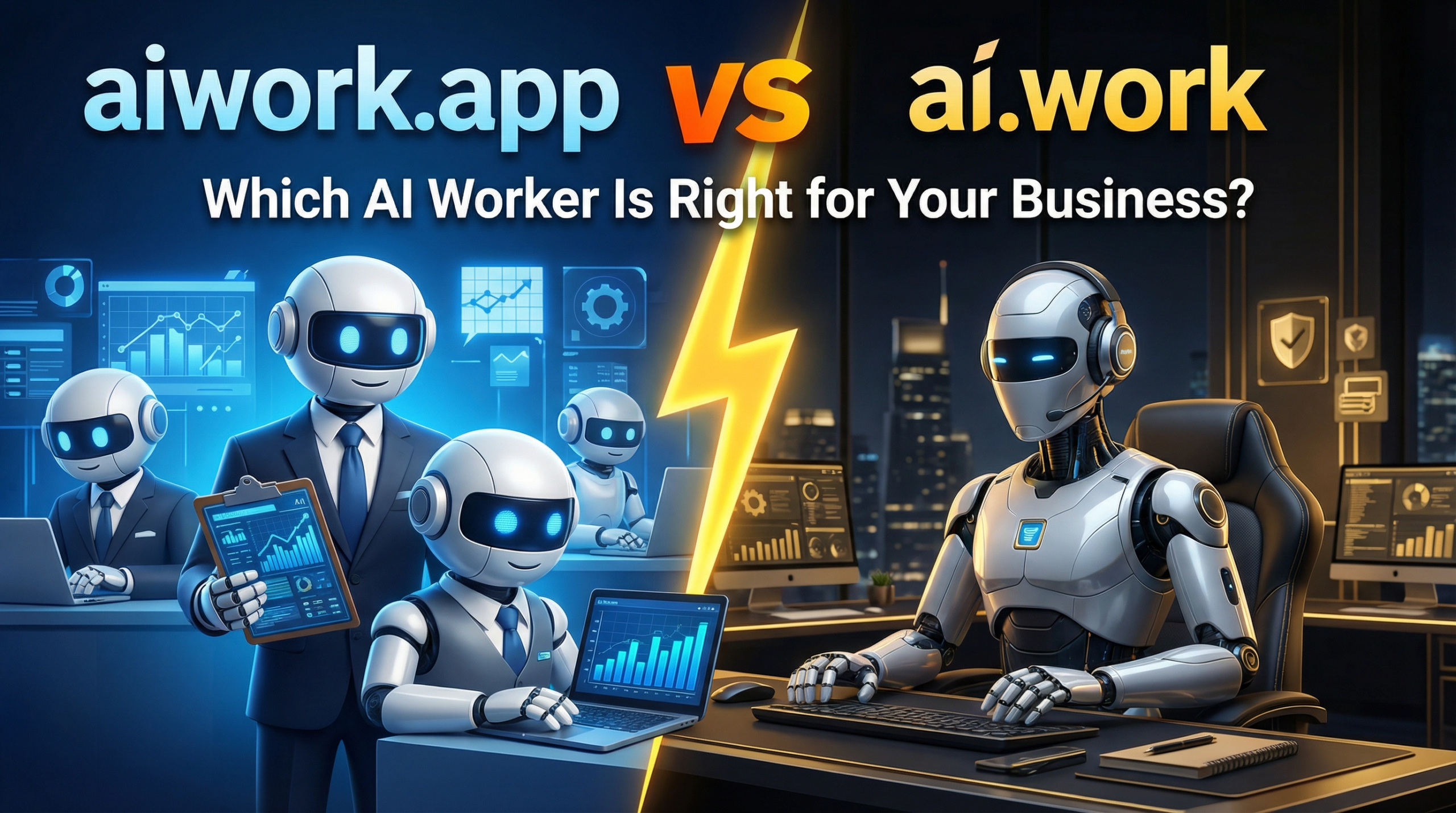
Compare ai.work and aiwork.app (Aiwork) in this clear breakdown of AI worker platforms. Learn how each AI worker differs in purpose, users, and use cases.
Key Takeaways
- ai.work and Aiwork are not direct competitors. They operate in different layers of work, one focused on enterprise systems and the other on individual productivity.
- ai.work is an AI worker built for internal enterprise automation, designed to execute actions across tools like IT service desks, access management systems, and internal workflows.
- Aiwork is a workspace of AI apps designed for output-driven tasks such as research, finance, hiring, and basic business operations.
- ai.work connects deeply into existing enterprise infrastructure, while Aiwork provides ready-to-use tools with no setup.
- Choosing between them depends on your bottleneck; ai.work solves internal operational overload, while Aiwork helps users produce work faster.
These two platforms look similar at first glance, but they solve completely different problems and sit in different layers of work.
One is designed to automate internal enterprise operations by connecting and acting across complex IT systems. The other is a workspace of AI tools built to help individuals and small teams produce business outputs directly.
If you are comparing them, you are not choosing between similar products. You are choosing between two different definitions of what an “AI worker” should do.
What Each AI Worker Platform Actually Does
aiwork.app
aiwork.app is a workspace of AI workers, branded as Aiwork, that users log into and operate directly.
Instead of relying on a single general-purpose agent, the platform is structured around multiple specialized AI apps, each designed for a specific type of output.
These include:
- Orion Insights for equity research and investment analysis
- Hermes X for real-time market alerts and tracking
- Luca for accounting and financial record handling
- Freddie for hiring and candidate workflows
Each AI app is purpose-built to complete a defined task from start to finish. Users open the workspace, choose the relevant tool, and immediately get results.
This makes aiwork.app a productivity layer focused on helping individuals and small teams produce work efficiently without setup or integration complexity.
ai.work
ai.work is an enterprise IT automation layer built around a single autonomous AI worker called Henry.
Henry connects directly to existing enterprise systems and executes tasks across them. It functions as an autonomous IT operator that can resolve requests, manage access, and run workflows without human intervention.
Rather than replacing existing tools, ai.work integrates with and operates across them. It sits on top of systems like ServiceNow, Jira, Okta, Google Workspace, and Slack, coordinating actions across multiple platforms in a single workflow.
This positions ai.work as infrastructure for enterprise environments, where value comes from deep system integration and automation of internal operations at scale.
Aiwork vs ai.work: Who Are They For?
Aiwork
Aiwork is built for investors, analysts, founders, and small teams that need to get work done quickly without dealing with infrastructure or setup complexity.
The platform is designed for outward-facing work where speed of insight and execution matters more than system-level automation. It is commonly used for research, finance, hiring, and general business operations.
Typical use cases include:
- Analyzing global equities and generating investment insights
- Tracking market movements in real time
- Handling basic accounting and financial tracking tasks
- Screening and evaluating candidates faster during hiring processes
The platform is most effective when the goal is to produce outputs quickly and consistently. If your main bottleneck is getting work done efficiently, Aiwork is the better fit.
ai.work
ai.work is built for IT teams, system administrators, and enterprise operations leaders who manage complex internal systems.
It is designed for environments where work happens across multiple tools that do not naturally communicate with each other. The platform focuses on reducing operational load inside organizations that deal with high volumes of internal requests and system-level complexity.
Typical problems it solves include:
- Password resets and access management requests
- Repetitive IT support tickets that occur daily
- Cross-system workflows that require manual coordination between tools
- Employee IT support delivered through channels like Slack or Microsoft Teams
The platform is most valuable in organizations where internal operations are slowing teams down. If your main bottleneck is managing internal systems and reducing operational overhead, ai.work is the more appropriate choice.
Aiwork vs ai.work: How They Integrate Into Your Workflow
Aiwork
Aiwork does not rely heavily on deep integrations with external systems. Instead, its AI apps are built as self-contained agents that handle specific tasks end to end.
You log into the platform and use each tool directly within the workspace. There is no need to connect or orchestrate multiple external systems to get value.
The strength of the platform comes from the AI apps themselves rather than from coordinating workflows across other software.
For example, if you need a stock analysis, you use Orion Insights. If you need to handle accounting entries, you use Luca AI. If you want to streamline hiring workflows, you use Freddie AI.
Each tool is designed to perform a clearly defined function, and you choose the one that matches the task at hand.
There is no dependency on existing infrastructure, which makes it easy to start and use immediately.
ai.work
For ai.work, integration is not a feature. It is the entire product.
The platform connects to more than 40 enterprise systems and can execute actions across all of them in a single flow. A single request can trigger multiple steps across different tools without requiring manual coordination.
For example, when an employee requests access, Henry can check internal policies, update permissions in Okta, log the activity in ServiceNow, and send confirmation in Slack. This all happens automatically.
There is no need to switch between tools or involve human operators for routine tasks.
This approach only delivers value in environments that already have a complex stack of systems and workflows in place.
Pricing and accessibility
Aiwork
Aiwork is designed to be accessible from day one. It offers a free tier, along with pay-as-you-go pricing and credit packs that allow users to scale usage over time.
You can get started immediately without going through a sales process or setup cycle. As your needs grow, you simply increase usage or purchase additional credits.
This model makes the platform practical for individuals and small teams who want flexibility and do not want to deal with procurement or long-term commitments.
ai.work
ai.work follows a traditional enterprise sales model. Pricing is not publicly available, and access typically begins with a demo and a structured onboarding process.
Deployment is customized based on the organization’s systems, workflows, and scale. This is standard for enterprise software that integrates deeply into existing infrastructure.
The value of the platform depends on how extensively it is integrated and how much operational workload it can automate and replace over time.
Security and control
Aiwork
Security is handled in a more standard, product-level way.
It relies on standard terms of use and privacy policies rather than enterprise-grade compliance frameworks.
There is less emphasis on certifications or advanced access controls because the platform is not designed to operate inside core enterprise infrastructure.
Instead, it focuses on generating outputs that users can apply in their own workflows outside the system.
ai.work
Security is a core part of the platform because it operates inside enterprise systems and executes actions on behalf of users.
The platform is designed with SOC 2 Type II readiness and GDPR alignment to meet enterprise compliance requirements. It also includes role-based access control, ensuring that permissions are tightly managed across different users and actions.
In addition, organizations can choose to use their own LLM, giving them greater control over data handling and model usage.
This level of security is important because ai.work is not just generating outputs. It is actively performing actions inside critical business systems.
ai.work vs Aiwork Quick Comparison
Category
Core model
Users
Value
Integrations
Pricing
Setup
ai.work vs Aiwork: Final Verdict
The difference between Aiwork and ai.work is not subtle. They solve different layers of work entirely. One helps individuals and small teams produce output quickly. The other replaces manual coordination inside complex enterprise systems.
Choosing between them depends less on features and more on where your bottleneck actually is.
Choose Aiwork if:
You need tools that directly help you produce work
Aiwork is built for output, not orchestration. You are not setting up infrastructure or connecting systems. You are opening tools and getting results immediately.
You work in research, finance, hiring, or general business operations
The platform is useful when your work involves analysis, decision support, or repetitive professional tasks like:
- Market and equity research
- Financial tracking and basic accounting
- Candidate screening and hiring workflows
- General productivity tasks across small teams
It is designed to support knowledge work where speed and clarity matter more than system-level automation.
You want something you can start using immediately
There is no onboarding process or integration requirement. You sign up and start using tools right away.
This makes it practical for individuals, founders, and small teams who need value on day one without procurement cycles or IT involvement.
Choose ai.work if:
You run a company with complex IT systems
ai.work is built for environments where work happens across many interconnected tools. It is not about generating outputs. It is about executing actions across systems.
If your organization depends on platforms like ServiceNow, Jira, Okta, Slack, and internal databases working together, this is the category it fits.
Your team is overwhelmed with repetitive internal requests
The platform is most useful when IT and operations teams are spending too much time on:
- Access requests and permissions
- Password resets and account management
- Repetitive support tickets
- Cross-system administrative workflows
It reduces this workload by automating execution directly inside your stack.
You want automation across your existing infrastructure
ai.work does not replace your tools. It connects to them.
It only becomes valuable when there is enough system complexity that manual coordination is slowing teams down. In that context, it acts as an execution layer that removes repetitive human work across multiple platforms.
The Bottom line
Aiwork is for getting work done faster.
ai.work is for removing work that should not require humans in the first place.
If your problem is output, choose Aiwork.
If your problem is operational overload inside enterprise systems, choose ai.work.