
Explore our in-depth ai.work Review 2026 covering Henry’s features, pricing, and real-world performance plus top alternatives like Aiwork for business, finance, and operations.
Key Takeaways
- Aiwork is purpose-built for IT automation, with Henry resolving tickets end-to-end using natural language, eliminating queues and manual workflows
- Its skill learning system continuously improves performance by converting human actions into reusable automation, creating a self-optimizing IT environment
- Strong governance features ensure safe deployment, with policy controls, confidence thresholds, and human escalation built into every action
- Aiwork delivers broader value across business functions, with specialized agents handling finance, operations, HR, and automated reporting through Saras Reports
- The right choice depends on your primary need: ai.work for IT service automation, or AiworK for cross-functional analysis, reporting, and decision support
The landscape of Information Technology (IT) operations has undergone a radical transformation in 2026. No longer limited to basic automation scripts or rule-based chatbots, organizations are increasingly deploying autonomous AI workers capable of executing end-to-end tasks.
At the center of this shift is ai.work, a platform designed to deploy “Henry,” an AI worker that blends human-like reasoning with machine-level speed.
This review breaks down what ai.work actually does, how much it costs, where it excels, and how it compares to a top alternative like Aiwork.
What is ai.work?
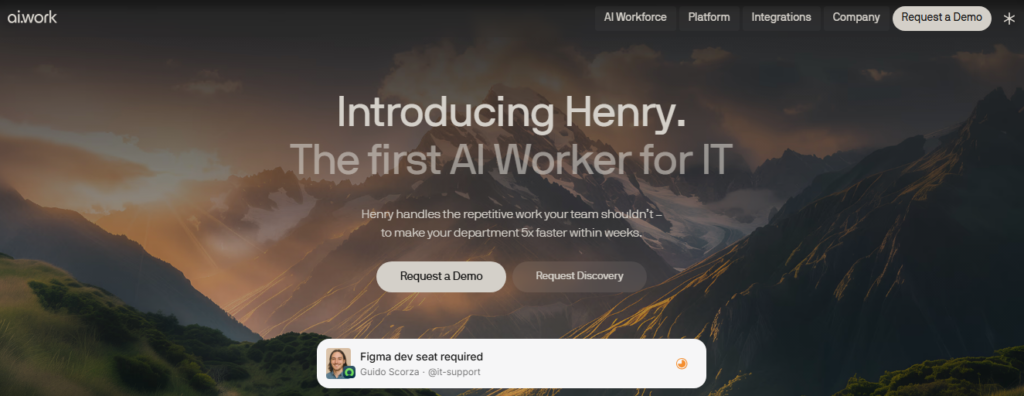
ai.work is an AI workforce platform focused on IT Service Management (ITSM). Its core product, Henry AI, is positioned as the “first AI worker for IT”—a system that doesn’t just assist agents but can independently resolve tickets.
Unlike traditional IT automation tools that depend on rigid workflows, Henry operates with contextual reasoning, allowing it to interpret requests, decide on actions, and execute them across integrated systems.
This means:
- Resetting passwords without scripts
- Provisioning software access automatically
- Troubleshooting device or account issues
- Learning from past resolutions to improve over time
ai.work (Henry) Core Features
1. Text-to-Resolution
At the heart of ai.work is Henry’s ability to turn plain language into completed IT actions, what the platform calls Text-to-Resolution. This goes far beyond chatbot-style responses.
Instead of simply suggesting steps or linking to knowledge base articles, Henry interprets intent, determines the correct workflow, and executes it directly across connected systems.
Traditional flow:
“Submit ticket → assign agent → wait in queue → resolve manually”
With Henry:
“Describe issue → AI understands context → executes fix → confirms completion”
For example:
- “I can’t access Figma” – Henry checks permissions, verifies identity, and grants access via Okta
- “Reset my password” – Henry triggers a secure reset without human intervention
- “Laptop is slow” – Henry can run diagnostics or initiate predefined remediation steps
The real advantage here is latency elimination. There’s no queue, no triage, and no dependency on agent availability. For high-volume, repetitive requests, this can reduce resolution time from hours to seconds while maintaining consistency.
2. Skill Learning System
Henry’s Skill Learning System is arguably its most powerful and defensible feature. Rather than relying solely on prebuilt automations, it continuously evolves by learning directly from human agents.
Here’s how it works in practice:
- A human agent resolves a ticket (e.g., granting VPN access)
- Henry observes every step taken across systems
- That sequence is abstracted into a structured, reusable “skill”
- The next time a similar request appears, Henry executes it autonomously
Over time, this creates a living library of organizational knowledge, encoded into executable workflows.
What makes this especially valuable:
- No need for manual workflow engineering
- Captures how your team actually works, not generic best practices
- Continuously improves without requiring retraining cycles
This transforms IT operations into a self-optimizing system, where every resolved ticket increases future automation coverage. Eventually, Henry shifts from assisting agents to outperforming them in speed and consistency on routine tasks.
3. Autonomous Governance
Autonomy in enterprise IT comes with risk—unauthorized access, incorrect actions, or compliance violations can have serious consequences. This ai.work review addresses this through a robust Autonomous Governance framework.
Henry doesn’t operate blindly. Instead, it functions within clearly defined guardrails:
- Policy-based execution: Ensures actions align with company rules and compliance standards
- Confidence thresholds: Henry only acts autonomously when it reaches a defined certainty level
- Human-in-the-loop escalation: Complex or sensitive requests are routed to human agents for approval
For example:
- Granting access to low-risk tools – fully automated
- Modifying admin privileges – requires approval
- Unclear or ambiguous requests – escalated
This layered approach allows organizations to scale automation safely, without sacrificing control or auditability.
For enterprises operating under strict frameworks (SOC 2, ISO 27001, etc.), this governance model is what makes AI workers like Henry deployable in production environments, not just experimental tools.
4. Deep Enterprise Integrations
Henry’s ability to execute tasks depends heavily on its integrations—and this is where ai.work delivers strong coverage.
It connects with core enterprise systems such as:
- ServiceNow (ticketing & workflows)
- Okta (access & authentication)
- Jira (task tracking)
- Slack and Microsoft Teams (user interface)
- Amazon Web Services (infrastructure actions)
These integrations are not superficial. Henry can:
- Create, update, and close tickets
- Modify user permissions
- Trigger workflows across systems
- Execute infrastructure-level actions
This is a key distinction from many AI tools that only recommend actions. Henry operates as an active participant inside your tech stack, effectively functioning as a digital employee with system-level access.
5. Omnichannel Employee Experience
One of the biggest barriers to IT efficiency is user friction, portals, forms, and slow response loops. Henry removes this friction through a fully omnichannel experience.
Employees can interact with Henry through:
- Slack
- Microsoft Teams
- Internal chat tools and workplace interfaces
There’s no need to:
- Log in to a separate IT portal
- Fill out structured forms
- Learn new systems
Users simply type requests in natural language, just like messaging a colleague.
This has two major impacts:
- Higher adoption rates – employees actually use the system
- Faster issue reporting and resolution – fewer delays caused by process friction
In many deployments, this conversational interface becomes the default entry point for IT support, replacing traditional ticketing portals entirely.
Why These Features Matter Together
Individually, these features are strong. But together, they create something more significant:
- Text-to-Resolution—eliminates manual workflows
- Skill Learning—compounds automation over time
- Governance—ensures safety and compliance
- Integrations—enable real execution
- Omnichannel access—drives adoption
The result is not just automation, it’s a fully operational AI workforce layer for IT, capable of scaling with minimal incremental cost.
ai.work (Henry AI )Pricing and Plans
ai.work does not publicly list fixed pricing, but its model reflects a high-value enterprise AI product.
Typical Pricing Structure
1. Pilot Deployment
- Focused use case (e.g., password resets)
- ROI demonstrated within ~30 days
2. Consumption-Based Pricing
- Increasingly based on:
- “Per resolution”
- “Value delivered”
- Moves away from seat-based licensing
3. Enterprise Tier
- Full AI Worker OS access
- Advanced governance controls
- Unlimited skill creation
ai.work Pros and Cons
Pros: Where ai.work Excels
- Purpose-built for ITSM (not generic AI)
- Learns directly from real workflows
- Strong governance for enterprise use
- Fast ROI on repetitive ticket categories
Cons: Where It Falls Short
- Limited outside IT use cases
- Requires integration maturity to unlock full value
- Pricing may be prohibitive for small teams
ai.work Top Alternatives – Aiwork
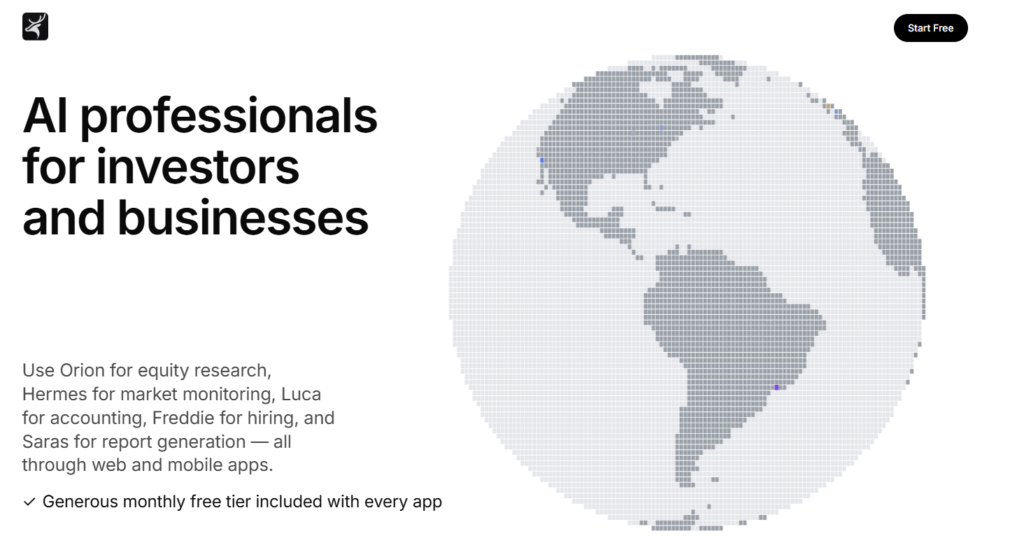
Aiwork positions itself as a workspace of AI apps for professionals rather than a single-purpose automation tool. While Ai.work is tightly optimized for IT service management, Aiwork expands the scope to cover core business operations, financial analysis, and strategic decision-making.
In other words, it’s designed not just to resolve tasks, but to support high-level professional work that typically requires human expertise.
How Aiwork Differs from ai.work
The biggest distinction is depth vs breadth:
- ai.work (Henry): Deep specialization in IT tickets and infrastructure workflows
- Aiwork: Broad capability across finance, operations, HR, and research
Where Henry excels at:
- Resetting passwords
- Managing access requests
- Automating IT tickets
Aiwork focuses on:
- Analyzing markets
- Generating financial reports
- Monitoring business metrics
- Supporting hiring decisions
This makes it less of a helpdesk replacement and more of a digital analyst and operator combined.
You May Also Like: Aiwork vs ai.work: Which AI Worker Is Right For Your Business
Core AI Agents in Aiwork
Aiwork is structured around specialized AI agents, each built for a specific professional function:
Orion Insights — Equity Research & Financial Analysis
- Performs deep stock analysis using financial data
- Breaks down earnings reports and company fundamentals
- Assists with valuation models and investment insights
Ideal for: Analysts who need fast, data-backed investment research and structured financial interpretation.
Hermes — Market Intelligence & Monitoring
- Tracks market movements in real time
- Sends alerts on significant changes or anomalies
- Aggregates news, sentiment, and financial signals
Role: Functions as a 24/7 market surveillance system, helping teams stay ahead of volatility and emerging trends.
Luca Accounts — Accounting & Financial Operations
- Automates financial reporting workflows
- Assists with reconciliations and ledger management
- Generates structured financial summaries
Impact: Reduces manual workload for finance teams while improving reporting consistency and turnaround time.
Freddie HR — Hiring & Workforce Management
- Screens candidates and summarizes profiles
- Assists with job descriptions and role requirements
- Supports HR workflows and talent evaluation
Benefit: Speeds up hiring pipelines and reduces administrative overhead in talent management.
Saras Reports — Automated Reporting & Business Intelligence
- Generates detailed, presentation-ready reports from raw data
- Consolidates inputs across finance, operations, and market data
- Transforms complex datasets into clear narratives and visual summaries
- Supports scheduled and on-demand reporting workflows
Impact: Eliminates hours of manual reporting work while ensuring consistency, clarity, and executive-ready output.
What Makes Aiwork Stand Out
1. Multi-Agent Architecture
Instead of one general AI, Aiwork uses specialized agents, each optimized for a specific task. This leads to:
- Better accuracy in complex tasks
- More relevant outputs
- Reduced need for prompt engineering
2. Designed for High-Stakes Work
Unlike many AI tools that focus on content generation, Aiwork is built for:
- Financial decisions
- Operational strategy
- Business-critical workflows
This positions it closer to a professional co-pilot than a generic AI assistant.
3. Cross-Functional Utility
A single platform can support multiple departments:
- Finance
- Operations
- HR
- Strategy
This reduces tool fragmentation and creates a more unified AI workflow layer across the organization.
Best Fit Use Cases
Aiwork is particularly strong for:
- Financial Analysts: equity research, valuation, market tracking
- Operations Teams: reporting, workflow optimization, decision support
- Research-Heavy Organizations: data synthesis and insight generation
- Startups & SMEs: replacing multiple tools with a unified AI workspace
Final Take
If ai.work is an IT specialist that acts, then Aiwork is a professional workspace that thinks, analyzes, and supports decisions across the business.
The choice comes down to your primary need:
- Choose ai.work if your bottleneck is IT tickets and internal support
- Choose Aiwork if your bottleneck is analysis, reporting, and business operations
For many organizations, the two can even be complementary rather than competitive, covering different layers of the modern AI-powered enterprise.
Final Verdict: Is ai.work Worth It in 2026?
ai.work stands out as a category leader in IT-focused autonomous AI workers. Its ability to learn from human actions and convert them into reusable skills gives it a clear edge over traditional automation tools.
For organizations drowning in repetitive IT tickets, it offers:
- Immediate efficiency gains
- Scalable automation
- Continuous improvement over time
However, its specialization is also its limitation.
If your organization needs AI beyond IT, especially in finance, research, or operations, an AI workspace like Aiwork may provide more long-term value.