
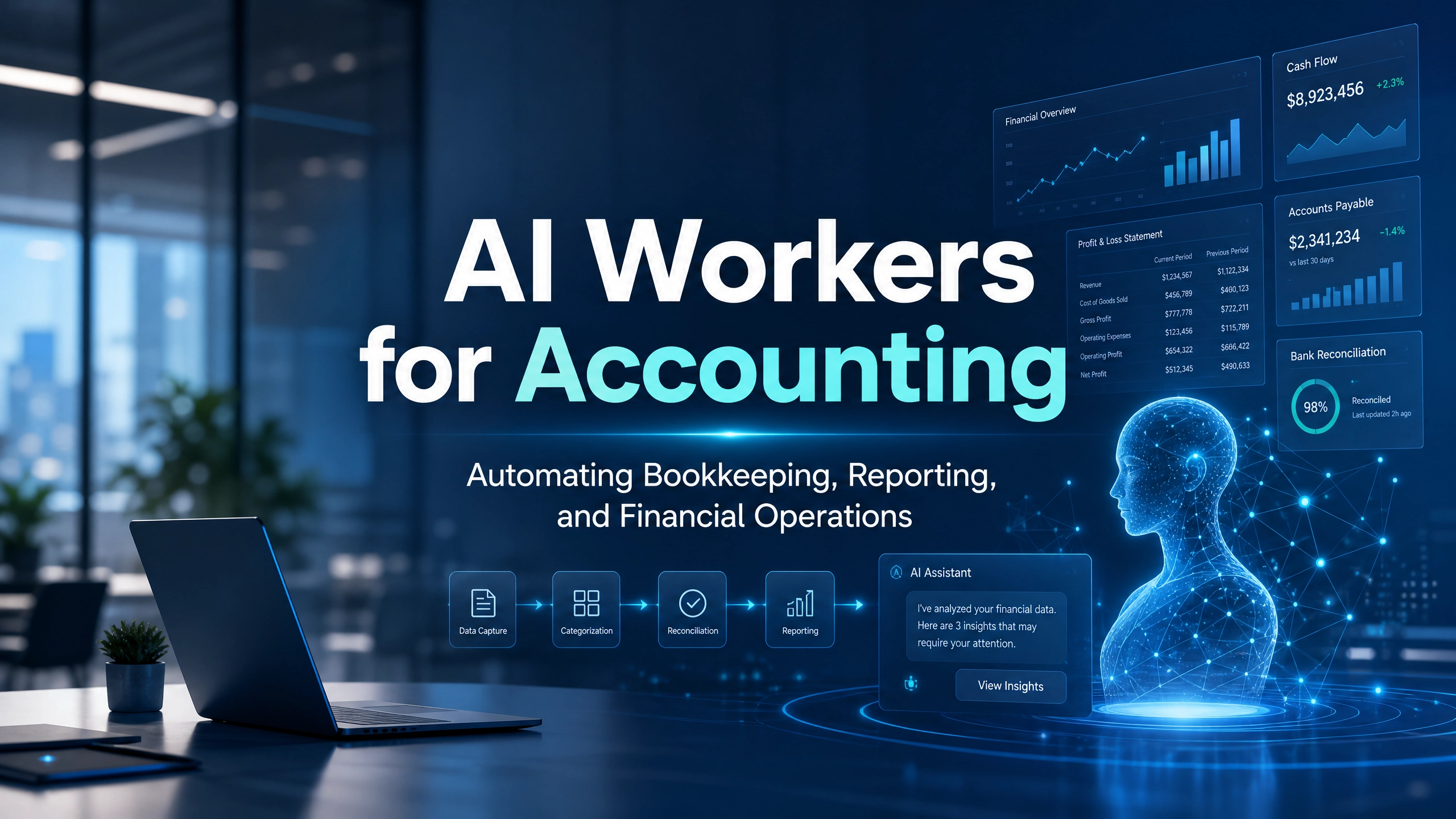
Discover how AI workers for accounting automate bookkeeping, financial reporting, reconciliation, and finance operations. Learn how AI accounting assistants help businesses improve accuracy, reduce manual work, and streamline financial workflows with solutions like Luca Accounts.
Key Takeaways
- AI workers for accounting help automate bookkeeping, reporting, reconciliation, accounts payable, and accounts receivable workflows, reducing the need for repetitive manual processes.
- Businesses are adopting AI-powered accounting solutions to improve accuracy, accelerate financial operations, and manage growing transaction volumes more efficiently.
- Advanced AI capabilities such as intelligent transaction categorization, anomaly detection, workflow prioritization, and financial insights go beyond traditional accounting automation.
- Organizations often benefit from accounting automation when reporting delays, spreadsheet dependency, reconciliation bottlenecks, and increasing operational complexity begin affecting performance.
- Platforms like Luca Accounts help centralize accounting workflows, improve financial visibility, streamline reporting, and support scalable finance operations.
Accounting teams are managing more financial data, higher transaction volumes, and increasing demands for faster reporting. Yet many businesses still rely on manual bookkeeping, spreadsheets, and time-consuming reconciliation processes that can slow operations and increase the risk of errors.
As financial workflows become more complex, organizations are turning to AI workers for accounting to automate routine tasks, improve accuracy, and streamline financial operations. From bookkeeping and reconciliation to reporting and workflow management, AI-powered systems help finance teams work more efficiently while maintaining greater visibility into business performance.
Solutions like Luca Accounts support this transformation by helping businesses centralize accounting workflows, automate repetitive processes, and manage financial operations from a single platform.
Why Businesses Are Adopting AI Workers for Accounting
Finance teams today are responsible for far more than recording transactions and preparing financial statements. They are expected to provide timely insights, support strategic decision-making, maintain compliance, and ensure financial operations run efficiently. As businesses grow, managing these responsibilities through manual processes becomes increasingly difficult.
AI workers for accounting are helping organizations modernize financial operations by automating repetitive tasks, reducing inefficiencies, and improving visibility across accounting workflows. Businesses are increasingly adopting AI-powered accounting solutions to address challenges such as:
- Rising transaction volumes
- Increasing reporting requirements
- Manual processing errors
- Slow and fragmented workflows
- The need to scale finance operations efficiently
Reducing Manual Accounting Errors
Accounting accuracy is critical, yet manual data entry and spreadsheet-based workflows often increase the risk of mistakes. Errors in transaction records, reconciliations, or reports can create downstream issues that affect financial visibility and decision-making. AI-powered systems help reduce these risks by standardizing workflows and automating repetitive tasks, resulting in more reliable financial data.
Supporting Scalable Finance Operations
Business growth often brings greater financial complexity, from higher transaction volumes to expanded reporting requirements. AI workers help organizations scale accounting operations without proportionally increasing administrative workload. By automating key processes, finance teams can support growth while maintaining efficiency, accuracy, and operational control.
Common Pain Points That Trigger AI Accounting Adoption
Many organizations begin exploring AI accounting automation when manual processes start creating operational bottlenecks. What once worked for a smaller business can quickly become difficult to manage as financial operations grow in complexity.
Common signs that a business may benefit from AI-powered accounting automation include:
- Financial reporting consistently takes longer than expected
- Accounting teams spend excessive time on manual data entry and reconciliation
- Transaction volumes are increasing faster than existing processes can handle
- Month-end closing becomes increasingly time-consuming
- Spreadsheet-based workflows are difficult to manage and maintain
- Financial information is spread across multiple systems
- Approval processes create delays and workflow bottlenecks
- Limited visibility makes it difficult to monitor accounting activities effectively
When these challenges begin affecting efficiency, reporting accuracy, or financial visibility, AI workers can help streamline workflows, reduce manual effort, and create a more scalable accounting operation.
Core Accounting Workflows AI Can Automate
AI workers can automate many routine accounting activities, helping finance teams manage financial operations more effectively.
AI Bookkeeping and Transaction Categorization
- Transaction recording
- Transaction categorization
- Expense classification
- Financial record organization
- Ledger maintenance
Invoice Processing and Accounts Payable Workflows
- Invoice collection
- Invoice validation
- Approval routing
- Payment scheduling
- Vendor payment tracking
Accounts Receivable Tracking and Payment Monitoring
- Customer payment tracking
- Outstanding invoice monitoring
- Overdue account identification
- Receivables management
- Cash flow monitoring
Bank Reconciliation and Transaction Matching
- Transaction matching
- Reconciliation workflows
- Discrepancy identification
- Account verification
- Month-end close support
Financial Reporting and Data Consolidation
- Financial statement preparation
- Data consolidation
- Report generation
- Reporting consistency
- Workflow visibility
Some AI-powered accounting platforms also support capabilities such as anomaly detection, intelligent transaction categorization, workflow prioritization, and financial insights that help finance teams identify issues and monitor performance more effectively.
Business Impact of AI Workers for Accounting
Organizations adopt AI workers for accounting not only to automate repetitive tasks but also to improve overall financial performance and operational efficiency. By reducing manual workloads and streamlining workflows, AI enables finance teams to operate more effectively while supporting broader business objectives.
Some of the most significant business outcomes include:
Improved Financial Accuracy
Manual accounting processes often introduce inconsistencies that can affect reporting and decision-making. AI workers help standardize workflows, reduce data entry errors, and maintain more reliable financial records across accounting operations.
Faster Access to Financial Insights
Finance teams can generate reports and access key financial information more quickly when data collection, consolidation, and reporting processes are automated. Faster access to information supports more timely and informed business decisions.
Greater Financial Visibility
AI-powered accounting systems provide a clearer view of financial activities, helping organizations monitor performance, track workflows, and identify issues before they become larger problems.
Increased Operational Efficiency
By automating routine accounting activities, organizations can reduce administrative effort and improve productivity. This allows finance teams to focus more on analysis, planning, and strategic initiatives that contribute to business growth.
Better Support for Business Growth
As organizations expand, accounting complexity often increases. AI workers help businesses manage larger transaction volumes, reporting requirements, and operational demands without significantly increasing administrative workload.
Ultimately, AI workers help transform accounting from a largely manual function into a more efficient, data-driven operation that supports better decision-making, stronger financial oversight, and long-term business growth.
AI Workers vs Traditional Accounting Automation
Traditional accounting automation has helped businesses reduce manual work for years, but modern AI workers take automation a step further. While both approaches improve efficiency, they differ significantly in how they process information, adapt to changing requirements, and support accounting operations.
Traditional automation is typically designed to follow predefined rules and execute specific tasks. AI workers, on the other hand, can analyze data, identify patterns, prioritize workflows, and provide insights that help finance teams make better decisions.
| Traditional Accounting Automation | AI Workers for Accounting |
| Rule-based workflows | Adaptive and intelligent workflows |
| Static processes | Dynamic process optimization |
| Limited decision support | AI-assisted insights |
| Requires frequent manual intervention | Greater workflow autonomy |
| Focused on task execution | Focused on workflow coordination |
| Reactive operations | Proactive workflow management |
| Limited ability to identify anomalies | Detects unusual transactions and patterns |
| Primarily process-driven | Data-driven and insight-oriented |
The key difference is that traditional automation focuses on completing predefined tasks, while AI workers help optimize the broader accounting workflow. This enables finance teams to move beyond basic process automation and gain greater operational visibility and efficiency.
Security, Accuracy, and Human Oversight in AI Accounting
The effectiveness of AI in accounting depends not only on automation but also on strong governance, security, and oversight. While AI workers can streamline financial processes and improve efficiency, organizations must ensure that appropriate controls are in place to maintain data integrity, regulatory compliance, and operational accountability.
Successful AI adoption requires a balanced approach where automation supports finance teams without eliminating the need for human review and decision-making.
Organizations should prioritize:
- Strong data security controls
- User access and permission management
- Comprehensive audit trails
- Approval and review workflows
- Human oversight of critical processes
- Continuous monitoring and performance evaluation
Protecting Financial Data and Maintaining Audit Trails
Accounting systems contain some of the most sensitive information within an organization. Protecting financial data is essential for maintaining trust, ensuring compliance, and reducing operational risk.
AI-powered accounting platforms should support secure data management practices while maintaining detailed audit trails that track transactions, approvals, workflow actions, and system changes. This level of transparency helps organizations improve accountability and simplifies financial reviews and audits.
Human Review and Approval Processes
Although AI can automate many accounting activities, human expertise remains essential. Finance professionals are responsible for reviewing outputs, validating financial information, approving critical transactions, and ensuring that accounting decisions align with organizational policies and requirements.
The most effective accounting environments combine AI-driven efficiency with human judgment, creating a balance between automation and oversight.
Real-World Use Cases of AI Workers for Accounting
AI workers are helping businesses automate accounting processes, improve financial visibility, and reduce manual workload. From small businesses to high-growth companies, AI supports more efficient and scalable financial operations.
AI Bookkeeping for Small Businesses
Small businesses often have limited accounting resources and growing financial responsibilities. AI can help by:
- Automatically categorizing transactions
- Maintaining organized financial records
- Reducing administrative workload
- Improving reporting readiness
- Simplifying reconciliation processes
By automating routine bookkeeping tasks, businesses can spend less time managing records and more time focusing on growth.
Automating Financial Operations for E-commerce and SaaS Companies
E-commerce and SaaS businesses often manage high transaction volumes, recurring payments, and complex revenue streams. AI can support:
- Subscription billing workflows
- High-volume transaction processing
- Revenue reporting
- Customer payment tracking
- Financial performance monitoring
This helps finance teams improve efficiency while maintaining greater visibility into financial performance.
Managing High-Volume Accounting Workflows
Organizations processing large amounts of financial data can use AI to:
- Streamline accounting workflows
- Improve transaction visibility
- Accelerate reporting cycles
- Maintain accounting consistency
- Reduce processing bottlenecks
- Support faster month-end closing
By automating repetitive accounting activities, businesses can manage increasing financial complexity without sacrificing accuracy or operational control.
How Luca Accounts Supports AI-Powered Accounting Operations
Luca Accounts helps businesses manage accounting operations through a centralized platform that supports:
- Automated bookkeeping workflows
- Financial reporting and visibility
- Accounting workflow management
- Financial record organization
- Monitoring of accounting activities
- Scalable finance operations
By bringing core accounting processes into a single environment, Luca Accounts helps finance teams maintain greater control over financial operations as their businesses grow.
Implementing AI Workers in Accounting Operations
Adopting AI accounting automation does not require a complete overhaul of existing processes. Most organizations achieve the best results by starting with repetitive, high-impact workflows and expanding automation over time.
Step 1: Identify High-Volume Manual Processes
Begin by reviewing accounting activities that consume significant time and resources, such as bookkeeping, invoice processing, reconciliation, and financial reporting. These areas often present the greatest opportunities for automation.
Step 2: Prioritize High-Impact Workflows
Focus on processes where automation can deliver immediate value through improved efficiency, faster reporting, and reduced manual effort. Starting with a few critical workflows helps teams demonstrate results quickly and build confidence in AI-powered accounting operations.
Step 3: Monitor Performance and Scale Gradually
Track improvements in processing speed, reporting timelines, accuracy, and productivity. As teams become more comfortable with automation, additional accounting workflows can be incorporated to support broader finance operations.
By taking a phased approach, businesses can implement AI workers more effectively while maintaining control, accuracy, and operational continuity.
FAQs
What are AI workers for accounting?
AI workers for accounting are AI-powered systems that help automate and support financial processes such as bookkeeping, transaction categorization, reconciliation, reporting, accounts payable, and accounts receivable management. They act as operational assistants that help finance teams work more efficiently while maintaining accuracy and visibility across accounting workflows.
Can AI replace accountants?
No. AI is designed to assist accountants rather than replace them. While AI can automate repetitive and time-consuming tasks, accountants remain responsible for financial oversight, strategic planning, compliance, analysis, and decision-making. The most effective finance teams combine AI-powered automation with human expertise.
Is AI accounting safe for businesses?
AI accounting solutions can be secure when supported by strong access controls, audit trails, data protection measures, and human oversight. Businesses should ensure that any accounting platform they adopt includes appropriate security and governance features to protect sensitive financial information.
How does Luca Accounts support accounting automation?
Luca Accounts helps businesses automate bookkeeping workflows, improve financial reporting visibility, centralize accounting operations, and manage financial processes more efficiently. By bringing key accounting activities into a single platform, it helps finance teams reduce manual effort while maintaining greater control over financial operations.
Conclusion
Accounting teams are under increasing pressure to deliver accurate financial information, manage growing transaction volumes, and support faster business decisions. As organizations scale, manual processes and spreadsheet-based workflows often become difficult to maintain, creating inefficiencies that can affect reporting accuracy, visibility, and overall operational performance.
AI workers for accounting help solve these challenges by automating repetitive financial tasks, streamlining workflows, and improving the efficiency of bookkeeping, reporting, reconciliation, accounts payable, and accounts receivable processes. Beyond automation, modern AI systems provide deeper operational insights that help finance teams make better-informed decisions and maintain greater control over financial operations.
As AI adoption continues to grow, businesses are increasingly using intelligent accounting solutions to improve accuracy, reduce administrative workload, and support scalable finance operations. Platforms like Luca Accounts help organizations centralize accounting workflows, improve reporting visibility, and create a more connected approach to financial management.
Businesses that embrace AI-powered accounting automation today will be better positioned to improve efficiency, strengthen financial oversight, and support long-term growth. Whether the goal is reducing manual bookkeeping, accelerating reporting cycles, or improving operational visibility, solutions like Luca Accounts provide a practical foundation for modernizing accounting operations.